4
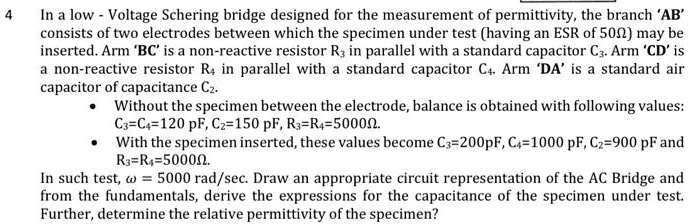
In a low - Voltage Schering bridge designed for the measurement of permittivity, the branch 'AB'
consists of two electrodes between which the specimen under test (having an ESR of 50\Omega) may be
inserted. Arm 'BC' is a non-reactive resistor $R_3$ in parallel with a standard capacitor $C_3$. Arm 'CD' is
a non-reactive resistor $R_4$ in parallel with a standard capacitor $C_4$. Arm 'DA' is a standard air
capacitor of capacitance $C_2$.
\begin{itemize}
\item Without the specimen between the electrode, balance is obtained with following values:
$C_3=C_4=120$ pF, $C_2=150$ pF, $R_3=R_4=5000\Omega$.
\item With the specimen inserted, these values become $C_3=200$pF, $C_4=1000$ pF, $C_2=900$ pF and
$R_3=R_4=5000\Omega$.
\end{itemize}
In such test, $\omega = 5000$ rad/sec. Draw an appropriate circuit representation of the AC Bridge and
from the fundamentals, derive the expressions for the capacitance of the specimen under test.
Further, determine the relative permittivity of the specimen?