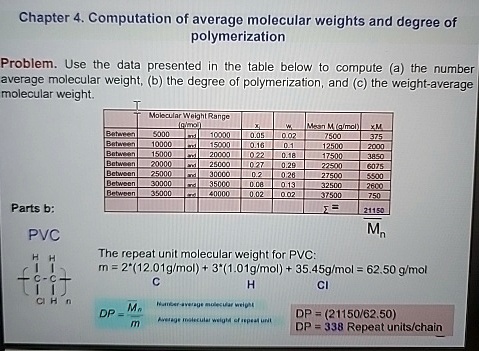
Chapter 4. Computation of average molecular weights and degree of polymerization
Problem. Use the data presented in the table below to compute (a) the number average molecular weight, (b) the degree of polymerization, and (c) the weight-average molecular weight.
able[[,,(2.05)/(0.01), able[[],[0.02],[0.1]],(MosM((q)/(m)ol))/(7500),(xM)/(375),,],[,5000,,],[,(10000)/(155000),m,-15000,,,12500,2000],[,,,,(022)/(027),(0.18)/(0.29),17500,],[ able[[bumwan],[Betwen]],(20000)/(25000),m,(250000)/(30000),(027)/(102),(0.29)/(0280),(225000)/(27500),(6075)/(500)
Chapter 4.Computation of average molecular weights and degree of polymerization
Problem. Use the data presented in the table below to compute (a the number average molecular weight,b the degree of polymerization,andc the weight-average molecular weight.
g/moll 5000 10000
0.02 0.1 0.18 0.29 026 0.15 0.02
anM(g/mol 7500 375 15000 0.16 12500 122 17500 20000 27 22500 6075 25000 5500 30000 35000 2600 35000 0.02 37500 750 21150 Ma The repeat unit molecular weight for PVC: m=2*12.01g/mol+3*1.01g/mol+35.45g/mol=62.50g/mol H CI DP=Mn DP=21150/62.50 m DP=338 Repeat units/chain
Parts b: PVC H H
1
CI Hn