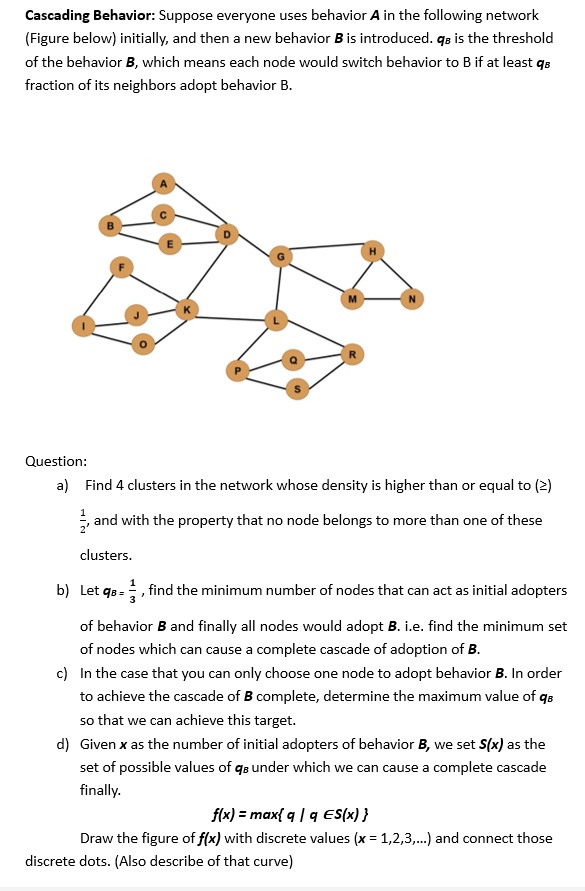
Cascading Behavior: Suppose everyone uses behavior A in the following network
(Figure below) initially, and then a new behavior B is introduced. $q_B$ is the threshold
of the behavior B, which means each node would switch behavior to B if at least $q_B$
fraction of its neighbors adopt behavior B.
A
C
B
D
E
H
G
F
J
M
N
K
L
R
Q
P
S
Question:
a) Find 4 clusters in the network whose density is higher than or equal to ($�rac{1}{2}$)
1
and with the property that no node belongs to more than one of these
clusters.
b) Let $q_B = \frac{1}{3}$, find the minimum number of nodes that can act as initial adopters
of behavior B and finally all nodes would adopt B. i.e. find the minimum set
of nodes which can cause a complete cascade of adoption of B.
c) In the case that you can only choose one node to adopt behavior B. In order
to achieve the cascade of B complete, determine the maximum value of $q_B$
so that we can achieve this target.
d) Given x as the number of initial adopters of behavior B, we set S(x) as the
set of possible values of $q_B$ under which we can cause a complete cascade
finally.
$f(x) = \max\{q \mid q \in S(x)\}$
Draw the figure of $f(x)$ with discrete values ($x = 1,2,3,...$) and connect those
discrete dots. (Also describe of that curve)