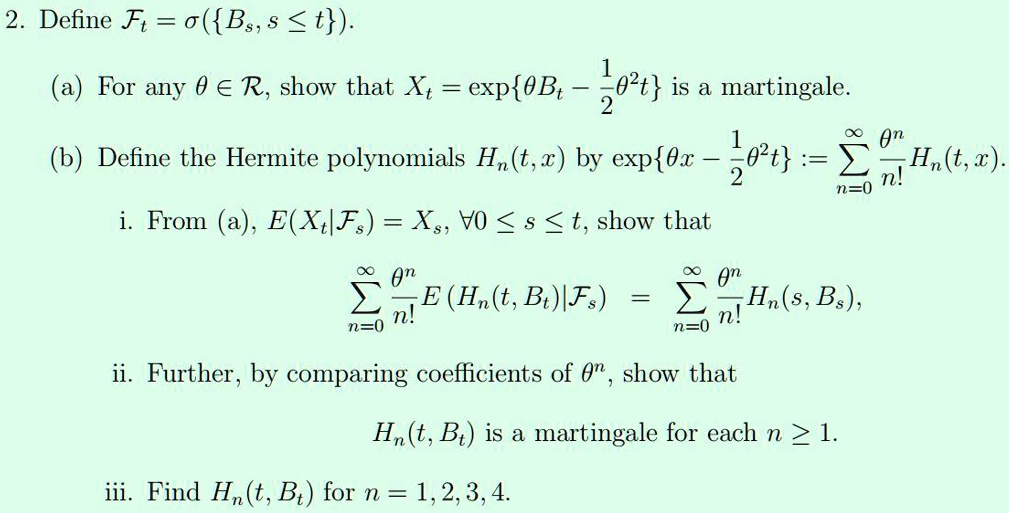
2. Define $\mathcal{F}_t = \sigma(\{B_s, s \le t\})$.
(a) For any $\theta \in \mathbb{R}$, show that $X_t = \exp\{\theta B_t - \frac{1}{2}\theta^2 t\}$ is a martingale.
(b) Define the Hermite polynomials $H_n(t, x)$ by $\exp\{\theta x - \frac{1}{2}\theta^2 t\} := \sum_{n=0}^{\infty} \frac{\theta^n}{n!} H_n(t, x)$.
i. From (a), $\mathbb{E}(X_t|\mathcal{F}_s) = X_s$, $\forall 0 \le s \le t$, show that
$\sum_{n=0}^{\infty} \frac{\theta^n}{n!} \mathbb{E}(H_n(t, B_t)|\mathcal{F}_s) = \sum_{n=0}^{\infty} \frac{\theta^n}{n!} H_n(s, B_s)$,
ii. Further, by comparing coefficients of $\theta^n$, show that
$H_n(t, B_t)$ is a martingale for each $n \ge 1$.
iii. Find $H_n(t, B_t)$ for $n = 1, 2, 3, 4$.