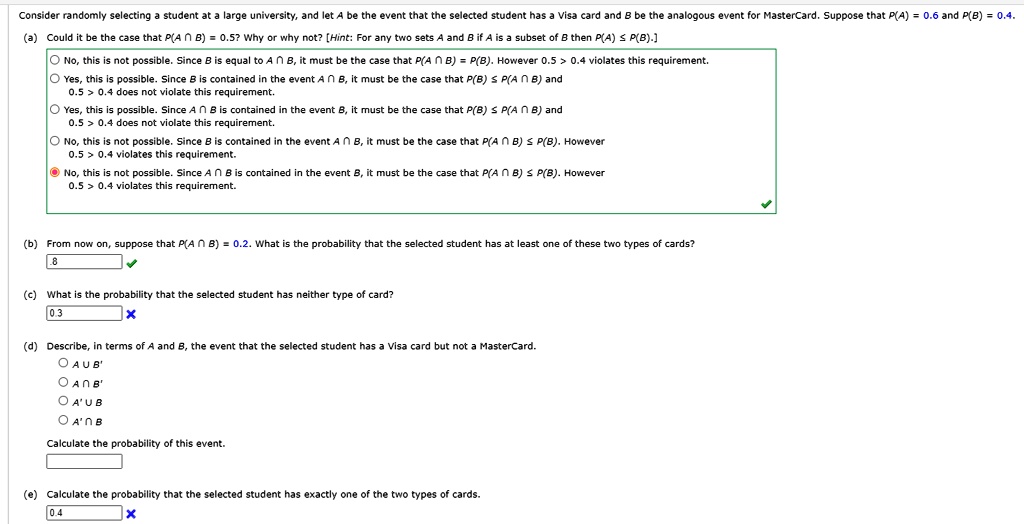
Consider randomly selecting a student at a large university, and let A be the event that the selected student has a Visa card and B be the analogous event for MasterCard. Suppose that P(A) = 0.6 and P(B) = 0.4.
(a) Could it be the case that P(A ∩ B) = 0.5? Why or why not? [Hint: For any two sets A and B if A is a subset of B then P(A) ≤P(B).]
No, this is not possible. Since B is equal to A ∩ B, it must be the case that P(A ∩ B) = P(B). However 0.5 > 0.4 violates this requirement.
Yes, this is possible. Since B is contained in the event A ∩ B, it must be the case that P(B) ≤ P(A ∩ B) and
0.5 > 0.4 does not violate this requirement.
Yes, this is possible. Since A ∩ B is contained in the event B, it must be the case that P(B) ≤ P(A ∩ B) and
0.5 > 0.4 does not violate this requirement.
No, this is not possible. Since B is contained in the event A ∩ B, it must be the case that P(A ∩ B) ≤ P(B). However
0.5 > 0.4 violates this requirement.
No, this is not possible. Since A ∩ B is contained in the event B, it must be the case that P(A ∩ B) ≤ P(B). However
0.5 > 0.4 violates this requirement.
(b) From now on, suppose that P(A ∩ B) = 0.2. What is the probability that the selected student has at least one of these two types of cards?
8
(c) What is the probability that the selected student has neither type of card?
0.3
X
(d) Describe, in terms of A and B, the event that the selected student has a Visa card but not a MasterCard.
AUB'
Ο ΑΠΒ'
OA'UB
OA'N B
Calculate the probability of this event.
(e) Calculate the probability that the selected student has exactly one of the two types of cards.
0.4
x