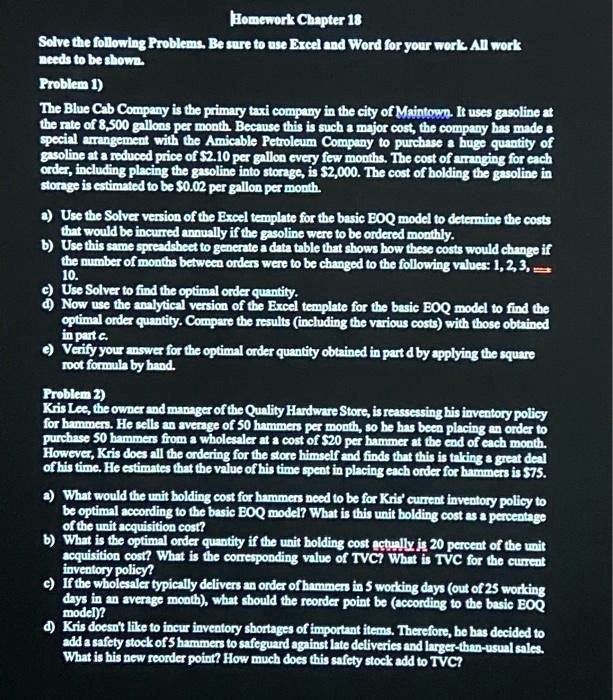
Texts: Homework Chapter 18
Solve the following problems. Be sure to use Excel and Word for your work. All work needs to be shown.
Problem 1) The Blue Cab Company is the primary taxi company in the city of Maintown. It uses gasoline at the rate of 8,500 gallons per month. Because this is such a major cost, the company has made a special arrangement with the Amicable Petroleum Company to purchase a huge quantity of gasoline at a reduced price of $2.10 per gallon every few months. The cost of arranging for each order, including placing the gasoline into storage, is $2,000. The cost of holding the gasoline in storage is estimated to be $0.02 per gallon per month.
a) Use the Solver version of the Excel template for the basic EOQ model to determine the costs that would be incurred annually if the gasoline were to be ordered monthly.
b) Use this same spreadsheet to generate a data table that shows how these costs would change if the number of months between orders were to be changed to the following values: 1, 2, 3, 10.
c) Use Solver to find the optimal order quantity.
d) Now use the analytical version of the Excel template for the basic EOQ model to find the optimal order quantity. Compare the results (including the various costs) with those obtained in part c. Verify your answer for the optimal order quantity obtained in part d by applying the square root formula by hand.
Problem 2) Kris Lee, the owner and manager of the Quality Hardware Store, is reassessing his inventory policy for hammers. He sells an average of 50 hammers per month, so he has been placing an order to purchase 50 hammers from a wholesaler at a cost of $20 per hammer at the end of each month. However, Kris does all the ordering for the store himself and finds that this is taking a great deal of his time. He estimates that the value of his time spent in placing each order for hammers is $75.
a) What would the unit holding cost for hammers need to be for Kris' current inventory policy to be optimal according to the basic EOQ model? What is this unit holding cost as a percentage of the unit acquisition cost?
b) What is the optimal order quantity if the unit holding cost actually is 20 percent of the unit acquisition cost? What is the corresponding value of TVC? What is TVC for the current inventory policy?
c) If the wholesaler typically delivers an order of hammers in 5 working days (out of 25 working days in an average month), what should the reorder point be (according to the basic EOQ model)?
d) Kris doesn't like to incur inventory shortages of important items. Therefore, he has decided to add a safety stock of 5 hammers to safeguard against late deliveries and larger-than-usual sales. What is his new reorder point? How much does this safety stock add to TVC?