Ace - AI Tutor
Ask Our Educators
Textbooks
My Library
Flashcards
Scribe - AI Notes
Notes & Exams
Download App
kevin potts

kevin p.

Divider

Questions asked

BEST MATCH

xyzhomework.com XYZ Homework Ace Al Tutor from Numerade Score on last try: 0 of 1 pts. See Details for more. Next question Get a similar question You can retry this question below For the following exercises, use the graph of \( f \) shown below Find \( f^{-1}(2) \). \[ f^{-1}(2)= \] \( \square \) Question Help: VIDEO Written Example Message instructor Submit Question

View Answer
divider
BEST MATCH

Find two teleological statements in an ecology textbook. Quote them verbatim and explain why they are teleological. Provide an alternative statement that conveys the most likely intended meaning without being teleological. Do not forget to list any references used.

View Answer
divider
BEST MATCH

The market for ski trips is at its market equilibrium when demand decreases. At the initial equilibrium price, a ______ of ski trips makes the price of a ski trip start to ______. A. surplus; rise B. shortage; rise C. surplus; fall D. shortage; fall

View Answer
divider
BEST MATCH

Determine a region whose area is equal to the given details. lim n→∞ Σ n i = 1 on [0, 2] on [0, 7] 0 on [0, 3] on [0, 6] on [1, 8] Show My Work (Optional)

View Answer
divider
BEST MATCH

A 2.52\times10^{-2} L sample of a solution of Cu$^+$ requires 3.19\times10^{-2} L of 0.132 M KMnO$_4$ solution to reach the equivalence point. The products of the reaction are Cu$^{2+}$ and Mn$^{2+}$. Part A What is the starting concentration of the Cu$^+$ solution?

View Answer
divider
BEST MATCH

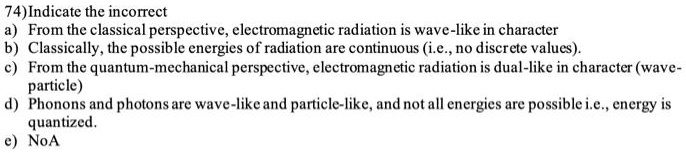
74) Indicate the incorrect a) From the classical perspective, electromagnetic radiation is wave-like in character b) Classically, the possible energies of radiation are continuous (i.e., no discrete values). c) From the quantum-mechanical perspective, electromagnetic radiation is dual-like in character (wave-particle) d) Phonons and photons are wave-like and particle-like, and not all energies are possible i.e., energy is quantized. e) NoA
View Answer
divider
BEST MATCH

Please show full work. Below are the information needed: 1- 0.3048m 1 psi - 6894.8 Pa 1 in - 9.9254 m water dynamic viscosity 90% Po - 910 kg/m w - 1000 kg/m g - 9.81 m/s^2 Bernoulli's equation in head: P/(p*g) + v^2/(2*g) + h + h_h = P/(p*g) + v^2/(2*g) + h + h_h_h_m P/(g + v)/(2*g*h) Major Head Loss equation: h_i - f*(1/(D*v)/(2*g)) Minor Head Loss equation: h_L_m/k*v/(2*g) Power of the pump: W_p = g*h_O*Q The volumetric flow rate: W - p*O*u The rotational velocity: n_d The tangential velocity: v Reminders: Pay attention to the final values of your answer. You can obtain at most 70% of the credits if the values are wrong. 11. Concept explanation: a) Gage pressure and Absolute pressure b) Laminar and turbulent flows c) Cavitation d) Siphoning effect 52. Determine the gage pressures in Pa at points AB and C in the diagram below, assuming the liquid is water. 53. Oil with kinematic viscosity v = 9.0000344 m/s flows through a 100 mm diameter pipe at 4 m/s. If the pipe is made of cast iron (e = 0.00026 m), determine the Reynolds number and the friction factor (using Moody Chart). 54. Water flows through a horizontal 2-inch diameter pipe. If the friction factor f = 0.028 and the flow rate is 0.006 ft^3/s, determine the head drop in m and pressure drop in Pa that occurs over a 3 ft section of pipe.

View Answer
divider
BEST MATCH

(15 points) An interconnect line runs over an insulating oxide layer that is 1,000 Aº thick. The line has a width of 0.5µm and is 50µm long. The sheet resistance is known to be 30?. a. (5 points) Find the line resistance $R_{line}$. b. (5 points) Find the line capacitance $C_{line}$. Use $\epsilon_{ox} = 3.12 \times 10^{-13} F/cm$, and express your answer in femtofarads (fF). c. (5 points) Find the time constant ($\tau$) for the line in units of picoseconds (ps).

View Answer
divider
BEST MATCH

Assignment *Don't forget to comment your program. Please check your files before submission. Wrong file, corrupted file, zip file will result in a grade of zero. This project may be very long and time consuming, start early and budget your time wisely! No late project will be accepted! This project has two parts: Part 1: 100 points Objective of this project: Utilizing loops in reading an array, utilizing searching and sorting arrays in an menu driven program. Failure to utilize the objectives will result in a grade of zero for this part. Submit your .cpp file as well as the screen shot of the output (not just the compiled program). Write a menu driven program that reads an array of 15 integer from standard keyboard (user) utilizing a loop and outputs the following depending on user's choice • Choice 1 - Prints the elements of array • Choice 2 - Prints the minimum value of the array • Choice 3 - Prints the maximum value of the array • Choice 4 - Prints the product of all the numbers utilizing a loop. • Choice 5 - Prints the sum of all the numbers utilizing a loop When the program is done, your program should ask the user if they would like to enter another set of 15 numbers and the program should repeat itself. Input validation: Your program should only accepts integers.

View Answer
divider
BEST MATCH

1. Choose a sampling rate of Fs = 40 kHz. 2. Create a vector t of 32768 time-sample points spaced according to this Fs, starting at 0 seconds. 3. Compute a vector x of 32768 samples of a 5400 Hz sinusoid with amplitude of square root of 2. 4. Plot the first 100 points of the sinusoid vs. time and verify it is the correct amplitude and frequency. Use the MATLAB line style "-o" to get a "line and circle" line style; the circles will show where the samples are. Notice the fact that the sample locations vary from cycle to cycle (because the frequency is not such that Fs is an integer multiple of it), which makes measuring the frequency from this time-domain plot a bit more difficult. Comment on your results. Can you get better accuracy by averaging together several measurements taken in different cycles? 5. Compute the DFT of the first 4096 points of the sinusoidal signal and plot the signal's DFT magnitude in dB vs. the frequency and verify the correct frequency.

View Answer
divider