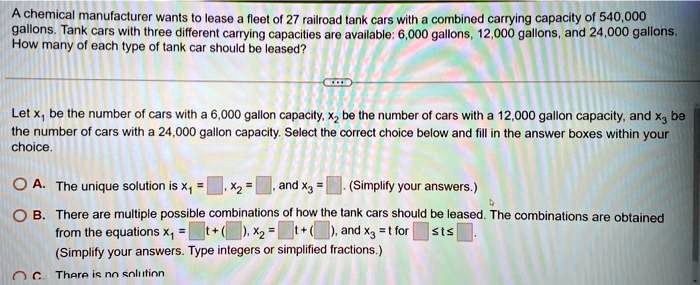
A chemical manufacturer wants to lease a fleet of 27 railroad tank cars with a combined carrying capacity of 540,000 gallons. Tank cars with three different carrying capacities are available: 6,000 gallons, 12,000 gallons, and 24,000 gallons. How many of each type of tank car should be leased?
Let $x_1$ be the number of cars with a 6,000 gallon capacity, $x_2$ be the number of cars with a 12,000 gallon capacity, and $x_3$ be the number of cars with a 24,000 gallon capacity. Select the correct choice below and fill in the answer boxes within your choice.
A. The unique solution is $x_1 = \Box$, $x_2 = \Box$, and $x_3 = \Box$. (Simplify your answers.)
B. There are multiple possible combinations of how the tank cars should be leased. The combinations are obtained from the equations $x_1 = \Box + \Box$, $x_2 = t + \Box$, and $x_3 = t$ for $\Box \le t \le \Box$. (Simplify your answers. Type integers or simplified fractions.)
C. There is no solution