Ace - AI Tutor
Ask Our Educators
Textbooks
My Library
Flashcards
Scribe - AI Notes
Notes & Exams
Download App
kim joseph

kim j.

Divider

Questions asked

BEST MATCH

Multiple Select Question Select all that apply What features would type AB blood have? Anti-A antibodies A antigens on cells Anti-B antibodies B antigens on cells

View Answer
divider
BEST MATCH

You are interested in whether smoking marijuana affects working memory. You design a study with two independent variables: Marijuana use (use or do no use) and Age (teenager or adult). The DV is a memory task. In this study, you would have to investigate ____ main effect(s) and ____ interaction effect(s). 2,1 1,2 2,3 2,2

View Answer
divider
BEST MATCH

Find the cross product $\mathbf{a} \times \mathbf{b}$ where $\mathbf{a} = (-3,-2,-2)$ and $\mathbf{b} = (-5,-2,0)$. $\mathbf{a} \times \mathbf{b} = (\quad,\quad,\quad)$ Find the cross product $\mathbf{c} \times \mathbf{d}$ where $\mathbf{c} = -4\mathbf{i} - 5\mathbf{j} + 1\mathbf{k}$ and $\mathbf{d} = 1\mathbf{i} - 2\mathbf{j} - 1\mathbf{k}$. $\mathbf{c} \times \mathbf{d} = \quad \mathbf{i} + \quad \mathbf{j} + \quad \mathbf{k}$ Submit answer Next item

View Answer
divider
BEST MATCH

Sophia's friends always enjoy talking to her, as she tries to see situations from their perspectives on a range of subjects. Sophia illustrates which implication of competent communication? Group of answer choices Competence can be learned. Competence is situational. Competent communicators are empathic. Competent communicators are committed.

View Answer
divider
BEST MATCH

The following reaction is at equilibrium in a closed 4L vessel: $N_2(g) + 3H_2(g) \rightleftharpoons 2NH_3(g)$ What will happen if the vessel volume is reduced to 3L? (Assume constant temperature.) A The amounts of reactants and products will not change. B The equilibrium will shift to the left, producing more $N_2(g)$ and $H_2(g)$. C The amounts of both reactants and products will increase. D The amounts of both reactants and products will decrease. E The equilibrium will shift to the right, producing more $NH_3(g)$.

View Answer
divider
BEST MATCH

Upon retirement, as discussed in class, what will be your biggest financial enemy? a. Age b. Taxes c. Inflation d. Depreciation of all assets.

View Answer
divider
BEST MATCH

Solve the problem. Franco borrows a total of $4900 in student loan from two lenders. One charges 4.4% simple interest and the other charges 5.8% simple interest. He is not required to pay off the principal for 3 yr. However, at the end of 3 yr, he will owe a total of $789.60 for interest from both loans. How much did he borrow from each lender? She borrowed $3400 at 4.4% and $1500 at 5.8%, She borrowed $1100 at 4.4% and $3800 at 5.8%. She borrowed $3800 at 4.4% and $1100 at 5.8%. She borrowed $1500 at 4.4% and $3400 at 5.8%.

View Answer
divider
BEST MATCH

1 point Question at position 8 The process of filtering out compelling evidence and focusing on aspects of a situation that confirms one's pre-existing beliefs and attitudes is known as:

View Answer
divider
BEST MATCH

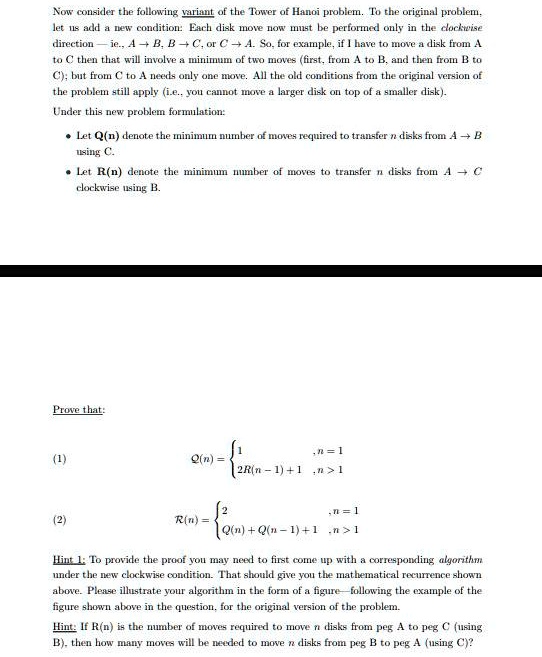
Now consider the following variant of the Tower of Hanoi problem. To the original problem, let us add a new condition: Each disk move now must be performed only in the clockwise direction — ie., A ? B, B ? C, or C ? A. So, for example, if I have to move a disk from A to C then that will involve a minimum of two moves (first, from A to B, and then from B to C); but from C to A needs only one move. All the old conditions from the original version of the problem still apply (i.e., you cannot move a larger disk on top of a smaller disk). Under this new problem formulation: • Let Q(n) denote the minimum number of moves required to transfer n disks from A ? B using C. • Let R(n) denote the minimum number of moves to transfer n disks from A ? C clockwise using B. Prove that: (1) $Q(n) = \begin{cases} 1 & , n = 1\\ 2R(n-1) + 1 & , n > 1 \end{cases}$ (2) $R(n) = \begin{cases} 2 & , n = 1\\ Q(n) + Q(n-1) + 1 & , n > 1 \end{cases}$ Hint 1: To provide the proof you may need to first come up with a corresponding algorithm under the new clockwise condition. That should give you the mathematical recurrence shown above. Please illustrate your algorithm in the form of a figure following the example of the figure shown above in the question, for the original version of the problem. Hint: If R(n) is the number of moves required to move n disks from peg A to peg C (using B), then how many moves will be needed to move n disks from peg B to peg A (using C)?
View Answer
divider
BEST MATCH

At what points is the following function continuous? \begin{equation*} f(x) = \begin{cases} \frac{x^2 - x - 2}{x - 2}, & x \neq 2 \\ 3, & x = 2 \end{cases} \end{equation*} The function is continuous on 2. (Type your answer in interval notation.)

View Answer
divider