2. Pyrophoric reagents. Butyllithium (BuLi) is an important reagent in organic synthesis and is routinely used for making pharmaceuticals and other materials. It is an extremely strong base that abstracts \( \mathrm{H}^{+} \) from even very weakly acidic molecules, and can form carbon-carbon bonds with certain types of organic compounds. BuLi's carbon-lithium bond places a strong, unstable negative charge on a carbon atom, which is the source of its extreme reactivity and the reason it is pyrophoric-spontaneously catching fire in air!
15 second video of the related compound \( t \)-butyllithium:
https://www.youtube.com/watch?v=e9VNaUY-ri4
Buli is synthesized as described in part (a) below. It is typically sold as a 1.0 M solution in hexanes, which is easily measured and added to reactions such as that in part (b). Because of its reactivity, BuLi degrades over time under typical storage conditions-usually in a fridge \( \left(4^{\circ} \mathrm{C}\right) \) or freezer \( \left(-20^{\circ} \mathrm{C}\right) \) in a septum-sealed reagent bottle. For this reason, chemists will often titrate older or previously opened solutions of BuLi in order to determine its exact concentration before use, as will be considered in part (c) below. If heavily compromised, it must be safely quenched before disposal, as in part (d).
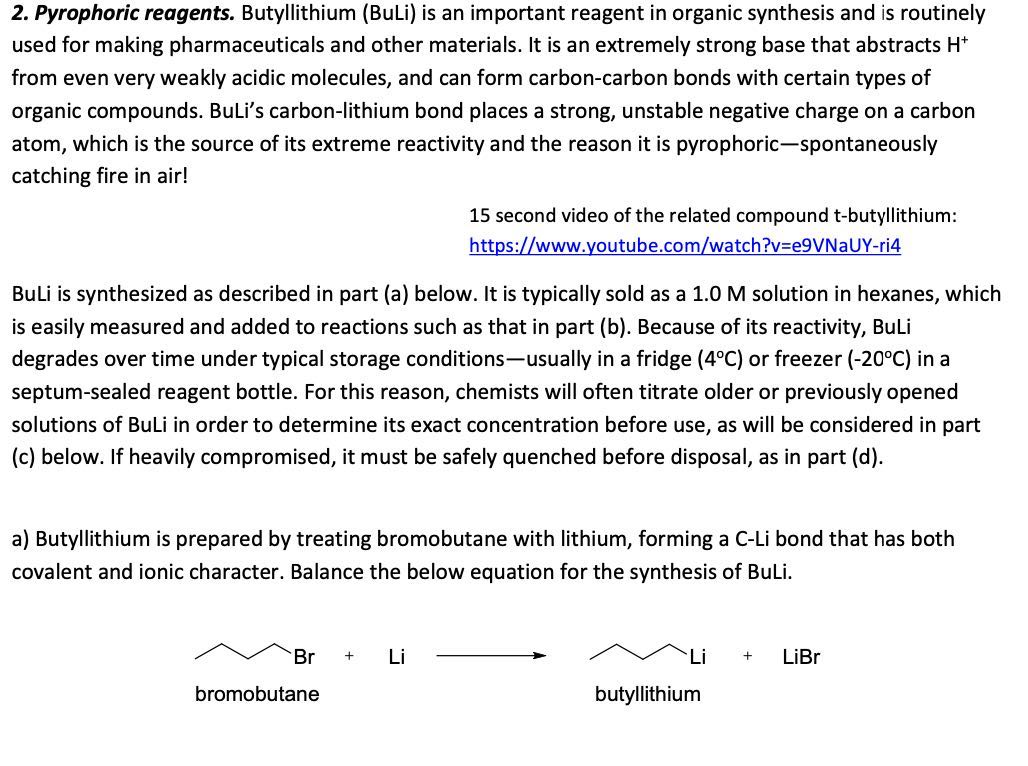
a) Butyllithium is prepared by treating bromobutane with lithium, forming a C-Li bond that has both covalent and ionic character. Balance the below equation for the synthesis of BuLi.