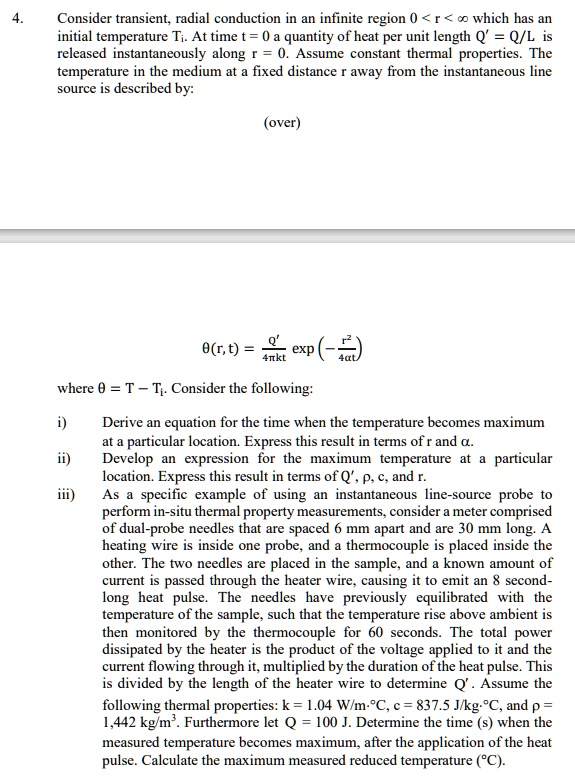
Consider transient, radial conduction in an infinite region 0 < r < ∞ which has an initial temperature Ti. At time t = 0, a quantity of heat per unit length Q' = Q/L is released instantaneously along r = 0. Assume constant thermal properties. The temperature in the medium at a fixed distance r away from the instantaneous line source is described by:
Θ = (Q / (4πk)) * (1 / √(αt)) * exp(-r^2 / (4αt))
where Θ = T - Ti. Consider the following:
i) Derive an equation for the time when the temperature becomes maximum at a particular location. Express this result in terms of r and α. Develop an expression for the maximum temperature at a particular location. Express this result in terms of Q, p, c, and r.
ii) As a specific example of using an instantaneous line-source probe to perform in-situ thermal property measurements, consider a meter comprised of dual-probe needles that are spaced 6 mm apart and are 30 mm long. A heating wire is inside one probe, and a thermocouple is placed inside the other. The two needles are placed in the sample, and a known amount of current is passed through the heater wire, causing it to emit an 8-second long heat pulse. The needles have previously equilibrated with the temperature of the sample, such that the temperature rise above ambient is then monitored by the thermocouple for 60 seconds. The total power dissipated by the heater is the product of the voltage applied to it and the current flowing through it, multiplied by the duration of the heat pulse. This is divided by the length of the heater wire to determine Q'. Assume the following thermal properties: k = 1.04 W/mC, c = 837.5 J/kgC, and p = 1,442 kg/m3. Furthermore, let Q = 100 J. Determine the time (s) when the measured temperature becomes maximum after the application of the heat pulse. Calculate the maximum measured reduced temperature (C).