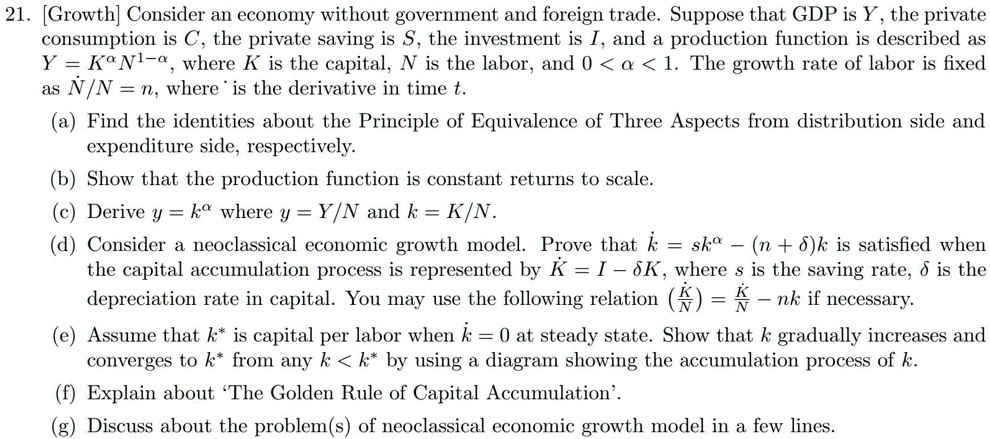
21. [Growth] Consider an economy without government and foreign trade. Suppose that GDP is Y, the private consumption is C, the private saving is S, the investment is I, and a production function is described as Y = KN^(1-a) where K is the capital, N is the labor, and 0 < a < 1. The growth rate of labor is fixed as N/N = n, where n is the derivative in time t.
(a) Find the identities about the Principle of Equivalence of Three Aspects from the distribution side and expenditure side, respectively.
(b) Show that the production function exhibits constant returns to scale.
(c) Derive y = k where y = Y/N and k = K/N.
(d) Consider a neoclassical economic growth model. Prove that k = sK - (n + δ)k is satisfied when the capital accumulation process is represented by K = I - δK, where s is the saving rate and δ is the depreciation rate in capital. You may use the following relation Y = K - nk if necessary.
(e) Assume that k* is the capital per labor when k = 0 at steady state. Show that k gradually increases and converges to k* from any k < k* by using a diagram showing the accumulation process of k.
(f) Explain the concept of "The Golden Rule of Capital Accumulation".
(g) Discuss the problem(s) of the neoclassical economic growth model in a few lines.