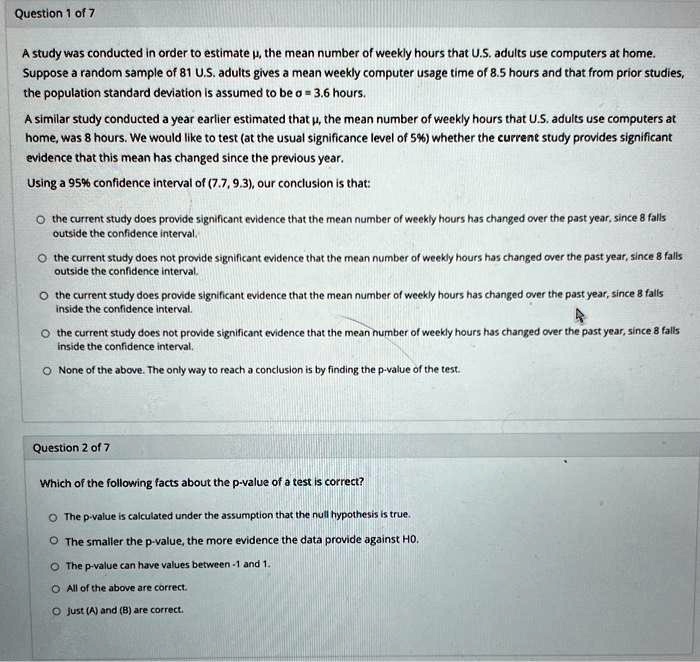
Texts: Question 1 of 7
A study was conducted in order to estimate the mean number of weekly hours that U.S. adults use computers at home.
Suppose a random sample of 81 U.S. adults gives a mean weekly computer usage time of 8.5 hours and that from prior studies the population standard deviation is assumed to be σ = 3.6 hours.
A similar study conducted a year earlier estimated that the mean number of weekly hours that U.S. adults use computers at home was 8 hours. We would like to test (at the usual significance level of 5%) whether the current study provides significant evidence that this mean has changed since the previous year.
Using a 95% confidence interval of (7.7, 9.3), our conclusion is that:
O the current study does provide significant evidence that the mean number of weekly hours has changed over the past year, since 8 falls outside the confidence interval.
O the current study does not provide significant evidence that the mean number of weekly hours has changed over the past year, since 8 falls outside the confidence interval.
O the current study does provide significant evidence that the mean number of weekly hours has changed over the past year, since 8 falls inside the confidence interval.
O the current study does not provide significant evidence that the mean number of weekly hours has changed over the past year, since 8 falls inside the confidence interval.
O None of the above. The only way to reach a conclusion is by finding the p-value of the test.
Question 2 of 7
Which of the following facts about the p-value of a test is correct?
O The p-value is calculated under the assumption that the null hypothesis is true.
O The smaller the p-value, the more evidence the data provide against HO.
O The p-value can have values between -1 and 1.
O All of the above are correct.
O Just (A and B) are correct.