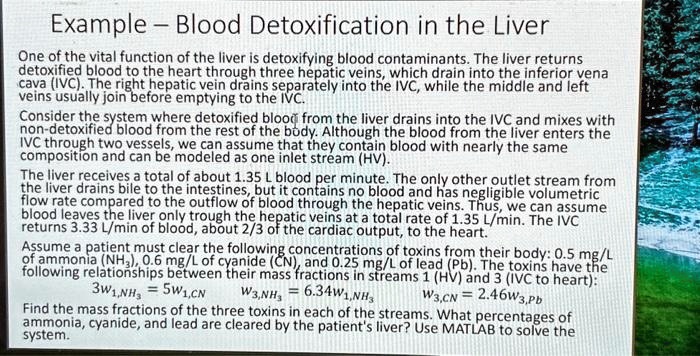
- Blood Detoxification in the Liver -
One of the vital functions of the liver is detoxifying blood contaminants. The liver returns detoxified blood to the heart through three hepatic veins, which drain into the inferior vena cava (IVC). The right hepatic vein drains separately into the IVC while the middle and left veins usually join before emptying into the IVC.
Consider the system where detoxified blood from the liver drains into the IVC and mixes with non-detoxified blood from the rest of the body. Although the blood from the liver enters the IVC through two vessels, we can assume that they contain blood with nearly the same composition and can be modeled as one inlet stream (HV). The liver receives a total of about 1.35 L of blood per minute. The only other outlet stream from the liver drains bile to the intestines, but it contains no blood and has a negligible volumetric flow rate compared to the outflow of blood through the hepatic veins. Thus, we can assume blood leaves the liver only through the hepatic veins at a total rate of 1.35 L/min. The IVC returns 3.33 L/min of blood, about 2/3 of the cardiac output, to the heart.
Assume a patient must clear the following concentrations of toxins from their body: 0.5 mg/L of ammonia (NH3), 0.6 mg/L of cyanide (CN), and 0.25 mg/L of lead (Pb). The toxins have the following relationships between their mass fractions in streams 1 (HV) and 3 (IVC to heart): 3W1NH=5W1, CN.
Find the mass fractions of the three toxins in each of the streams. What percentages of ammonia, cyanide, and lead are cleared by the patient's liver? Use MATLAB to solve the system.