Ace - AI Tutor
Ask Our Educators
Textbooks
My Library
Flashcards
Scribe - AI Notes
Notes & Exams
Download App
kimberly jenkins

kimberly j.

Divider

Questions asked

BEST MATCH

You and your crew are up next in the Math Battle. The beat kicks on. The lights kick on. You hear the voice of the host, "Reverse the order of integration. Then evaluate the double integral. If you fail to do this, we will eat your neighbors!" Save the neighborhood! [7 pts] $$ \int_{0}^{2\sqrt{2y}} \int_{y^2}^{2\sqrt{2y}} (x^2y - xy^2) dx dy $$

View Answer
divider
BEST MATCH

What do you think about the spatial fix for reasons of economics and the ethics of the risks and hazards to the workers in Maquilapolis, relative to the improvement in their earnings. What should be done differently?

View Answer
divider
BEST MATCH

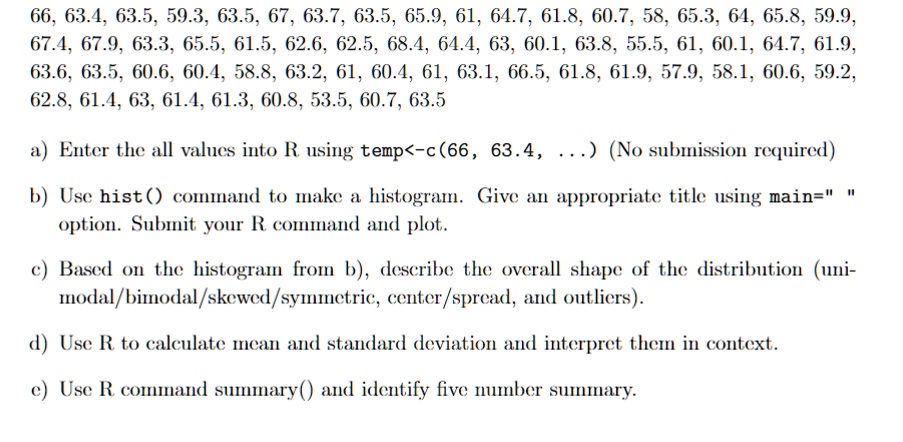
66, 63.4, 63.5, 59.3, 63.5, 67, 63.7, 63.5, 65.9, 61, 64.7, 61.8, 60.7, 58, 65.3, 64, 65.8, 59.9, 67.4, 67.9, 63.3, 65.5, 61.5, 62.6, 62.5, 68.4, 64.4, 63, 60.1, 63.8, 55.5, 61, 60.1, 64.7, 61.9, 63.6, 63.5, 60.6, 60.4, 58.8, 63.2, 61, 60.4, 61, 63.1, 66.5, 61.8, 61.9, 57.9, 58.1, 60.6, 59.2, 62.8, 61.4, 63, 61.4, 61.3, 60.8, 53.5, 60.7, 63.5 a) Enter the all values into R using \texttt{temp<-c(66, 63.4, ...)} (No submission required) b) Use \texttt{hist()} command to make a histogram. Give an appropriate title using \texttt{main="} option. Submit your R command and plot. c) Based on the histogram from b), describe the overall shape of the distribution (uni- modal/bimodal/skewed/symmetric, center/spread, and outliers). d) Use R to calculate mean and standard deviation and interpret them in context. e) Use R command \texttt{summary()} and identify five number summary.
View Answer
divider
BEST MATCH

A ____ is a short descriptive label that you assign to webpages, photos, videos, blog posts, email messages, and other digital content so that it is easier locate at a later time. 1) tag 2) bookmark 3) address 4) hash

View Answer
divider
BEST MATCH

United States has been running a current account deficit, which means that Question 8 options: We buy more from abroad than sell We earn less income from the world than paying out We unevenly trade with the rest of the world All of the above

View Answer
divider
BEST MATCH

3.36 Water flows upward through a variable area pipe with a constant flowrate, Q, as shown in Fig. P3.36. If viscous effects are negligible, determine the diameter, D(z), in terms of D_(1) if the pressure is to remain constant throughout the pipe. That is, p(z)=p_(1). 3.36 Water flows upward through a variable area pipe with a constant flowrate, Q, as shown in Fig. P3.36. If viscous ef- fects are negligible, determine the diameter, D(z), in terms of D, if the pressure is to remain constant throughout the pipe That is, p(z) = Pi D(z 12 (1) FIGURE

View Answer
divider
BEST MATCH

Consider how a tariff affects a single market, say that of corn. In the absence of trade, the price of corn is lower at Home than it is in Foreign. What is going to happen to the price of corn in the Home and in the Foreign country if the Home country imports corn from the foreign country? a. Home Market: Price Rises - Foreign Market Price Falls b. Home Market: Price Rises - Foreign Market Price Rises c. Home Market: Price Falls - Foreign Market Price Rises d. Home Market: Price Falls - Foreign Market Price Falls e. None of the other options

View Answer
divider
BEST MATCH

When mapping one-to-many binary relationships, which of the following about Primary Key (PK) Foreign Key (FK) is TRUE: - Create a new relation with PKs from two entities as its PK - PK on one side becomes a FK on the many side - PKs and FKs on both sides - PK on the many side becomes a FK on one side

View Answer
divider
BEST MATCH

Texts: What are the effects of each of the following on the U.S. international investment position? a. Foreign central banks increase their official holdings of U.S. government securities. b. U.S. residents increase their holdings of stocks issued by Japanese companies. c. A British pension fund sells some of its holdings of the stocks of U.S. companies in order to buy U.S. corporate bonds. 2. On December 31, a country has the following stocks of international assets and liabilities to foreigners. The country’s residents own $30 billion of bonds issued by foreign governments. The country’s central bank holds $20 billion of gold and $15 billion of foreign currency assets as official reserve assets. Foreign firms have invested in production facilities in the country, with the value of their investments currently $40 billion. Residents of foreign countries own $25 billion of bonds issued by the country’s companies. a. What is the value of the country’s international investment position? Is the country an international creditor or debtor? b. If the country runs a surplus in its current account during the next year, what will be the impact on the value of the country’s international investment position?

View Answer
divider
BEST MATCH

Question 2 Slide 7 Taxing Goods versus Lump Sum Taxes: A Carbon Tax, roughly speaking, is a tax on the use of energy sources that come from burning carbon based fuel (e.g. gasoline, oil, coal, etc...). The intention of a carbon tax is to reduce consumption of carbon based fuel sources. Assume you have a monthly electricity budget of $100 and that all of your electricity comes from a coal fired powerplant. The price of electricity to you is 1. Graph your budget constraint. Your town places a tax on your electricity equal to whatever the price of electricity happens to be, effectively doubling the price of electricity. Add the after tax budget constraint. Let's say you used to spend half of your monthly electricity budget before the tax, and continue to spend half of your monthly electricity budget after your tax. Add these two consumption bundles to the graph. Your town decides that although it wants to increase the price of electricity, it does not want to decrease total consumption, so at the end of each month you get a cash refund equal to the amount of money you spent on taxes on electricity. Add this new budget to your budget constraint. (Hint: You know the size of the tax. You know how much electricity you consumed. The amount you spend on taxes is the size of the tax times the amount of electricity you consumed.)

View Answer
divider