Homework (Ch 16)
Due on Tomorrow at 11:59 PM CDT
Back to Assignment
Attempts:
Average: /5
8. The reserve requirement, open market operations, and the moneysupply
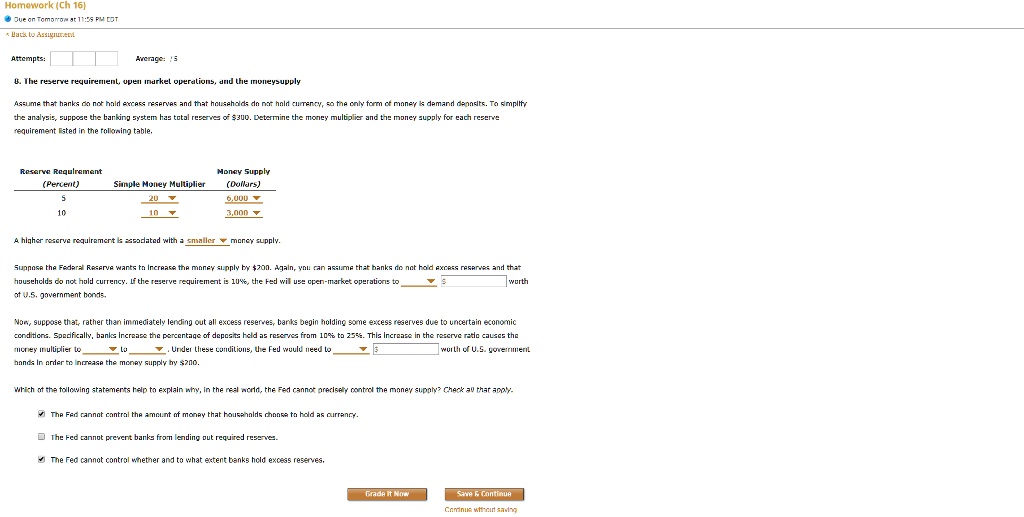
Assume that banks do not hold excess reserves and that households do not hold currency, so the only form of money is demand deposits. To simplify
the analysis, suppose the banking system has total reserves of $300. Determine the money multiplier and the money supply for each reserve
requirement listed in the following table.
Reserve Requirement
Money Supply
(Percent)
Simple Money Multiplier
(Dollars)
5
20
6,000
10
10
3,000
A higher reserve requirement is associated with a smaller money supply.
Suppose the Federal Reserve wants to increase the money supply by $200. Again, you can assume that banks do not hold excess reserves and that
households do not hold currency. If the reserve requirement is 10%, the Fed will use open-market operations to
worth
of U.S. government bonds.
Now, suppose that, rather than immediately lending out all excess reserves, banks begin holding some excess reserves due to uncertain economic
conditions. Specifically, banks increase the percentage of deposits hold as reserves from 10% to 25%. This increase in the reserve ratio causes the
money multiplier to
Under these conditions, the Fed would need to
worth of U.S. government
bonds in order to increase the money supply by $200.
Which of the following statements help to explain why, in the real world, the Fed cannot precisely control the money supply? Check all that apply.
The Fed cannot control the amount of money that households choose to hold as currency.
The Fed cannot prevent banks from lending out required reserves.
The Fed cannot control whether and to what extent banks hold excess reserves.
Grade It Now
Save & Continue
Continue without saving