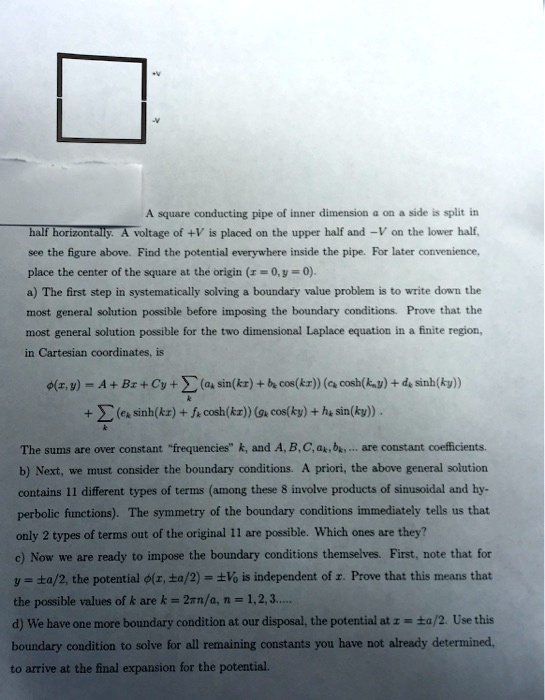
A square conducting pipe of inner dimension a on a side is split in
half horizontally. A voltage of +V is placed on the upper half and -V on the lower half,
see the figure above. Find the potential everywhere inside the pipe. For later convenience,
place the center of the square at the origin (x = 0, y = 0).
a) The first step in systematically solving a boundary value problem is to write down the
most general solution possible before imposing the boundary conditions. Prove that the
most general solution possible for the two dimensional Laplace equation in a finite region,
in Cartesian coordinates, is
$\phi(x, y) = A + Bx + Cy + \sum_{k} (a_k \sin(kx) + b_k \cos(kx)) (c_k \cosh(ky) + d_k \sinh(ky))$
$\qquad + \sum_{k} (e_k \sinh(kx) + f_k \cosh(kx)) (g_k \cos(ky) + h_k \sin(ky)).$
The sums are over constant \"frequencies\" k, and A, B, C, $a_k$, $b_k$,... are constant coefficients.
b) Next, we must consider the boundary conditions. A priori, the above general solution
contains 11 different types of terms (among these 8 involve products of sinusoidal and hy-
perbolic functions). The symmetry of the boundary conditions immediately tells us that
only 2 types of terms out of the original 11 are possible. Which ones are they?
c) Now we are ready to impose the boundary conditions themselves. First, note that for
y = \pm a/2, the potential $\phi(x, \pm a/2) = \pm V_0$ is independent of x. Prove that this means that
the possible values of k are k = $2\pi n/a$, n = 1, 2, 3.....
d) We have one more boundary condition at our disposal, the potential at x = \pm a/2. Use this
boundary condition to solve for all remaining constants you have not already determined,
to arrive at the final expansion for the potential.