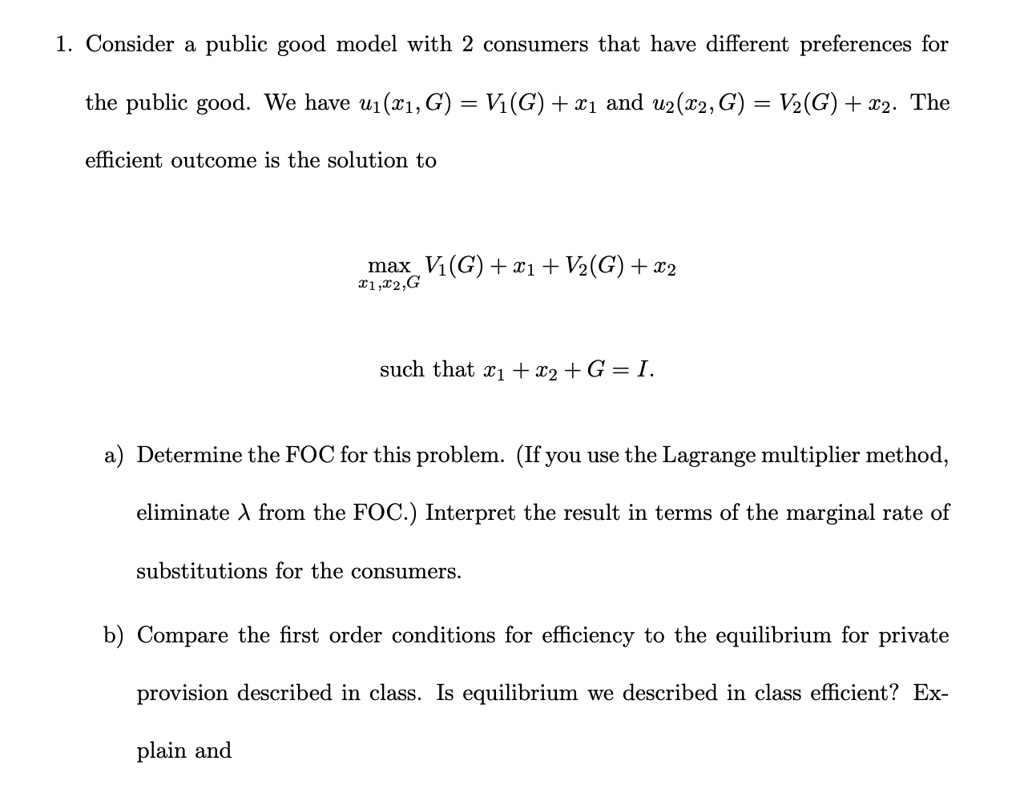
1. Consider a public good model with 2 consumers that have different preferences for
the public good. We have $u_1(x_1, G) = V_1(G) + x_1$ and $u_2(x_2, G) = V_2(G) + x_2$. The
efficient outcome is the solution to
$\max_{x_1, x_2, G} V_1(G) + x_1 + V_2(G) + x_2$
such that $x_1 + x_2 + G = I$.
a) Determine the FOC for this problem. (If you use the Lagrange multiplier method,
eliminate $\lambda$ from the FOC.) Interpret the result in terms of the marginal rate of
substitutions for the consumers.
b) Compare the first order conditions for efficiency to the equilibrium for private
provision described in class. Is equilibrium we described in class efficient? Ex-
plain and