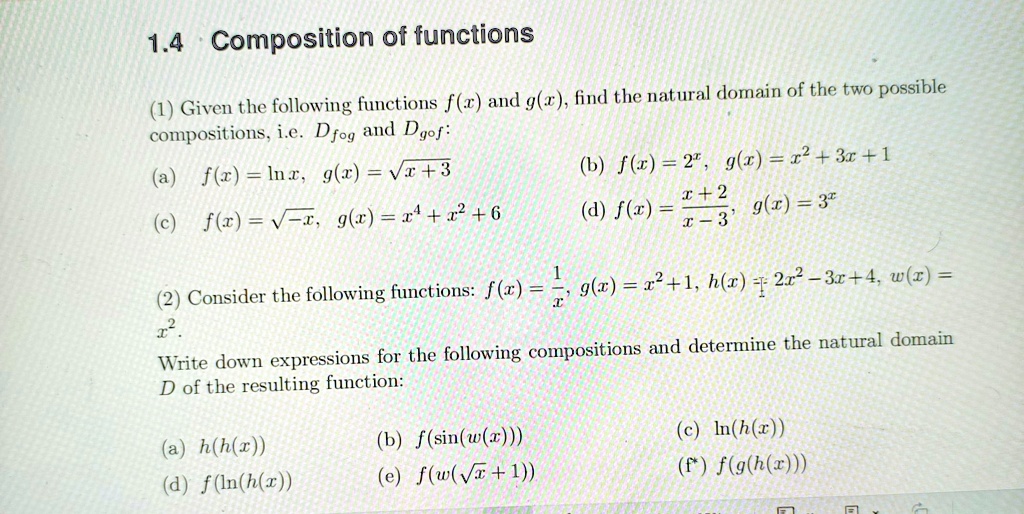
1.4 Composition of functions
(1) Given the following functions $f(x)$ and $g(x)$, find the natural domain of the two possible
compositions, i.e. $D_{fog}$ and $D_{gof}$:
(a) $f(x) = \ln x$, $g(x) = \sqrt{x+3}$
(c) $f(x) = \sqrt{-x}$, $g(x) = x^4 + x^2 + 6$
(b) $f(x) = 2^x$, $g(x) = x^2 + 3x + 1$
(d) $f(x) = \frac{x+2}{x-3}$, $g(x) = 3^x$
(2) Consider the following functions: $f(x) = \frac{1}{x}$, $g(x) = x^2 + 1$, $h(x) = 2x^2 - 3x + 4$, $w(x) = x^2$.
Write down expressions for the following compositions and determine the natural domain
D of the resulting function:
(a) $h(h(x))$
(d) $f(\ln(h(x))$
(b) $f(\sin(w(x)))$
(c) $\ln(h(x))$
(e) $f(w(\sqrt{x+1}))$
(f) $f(g(h(x))) $