A
1
7
2
3
1
5
D
B
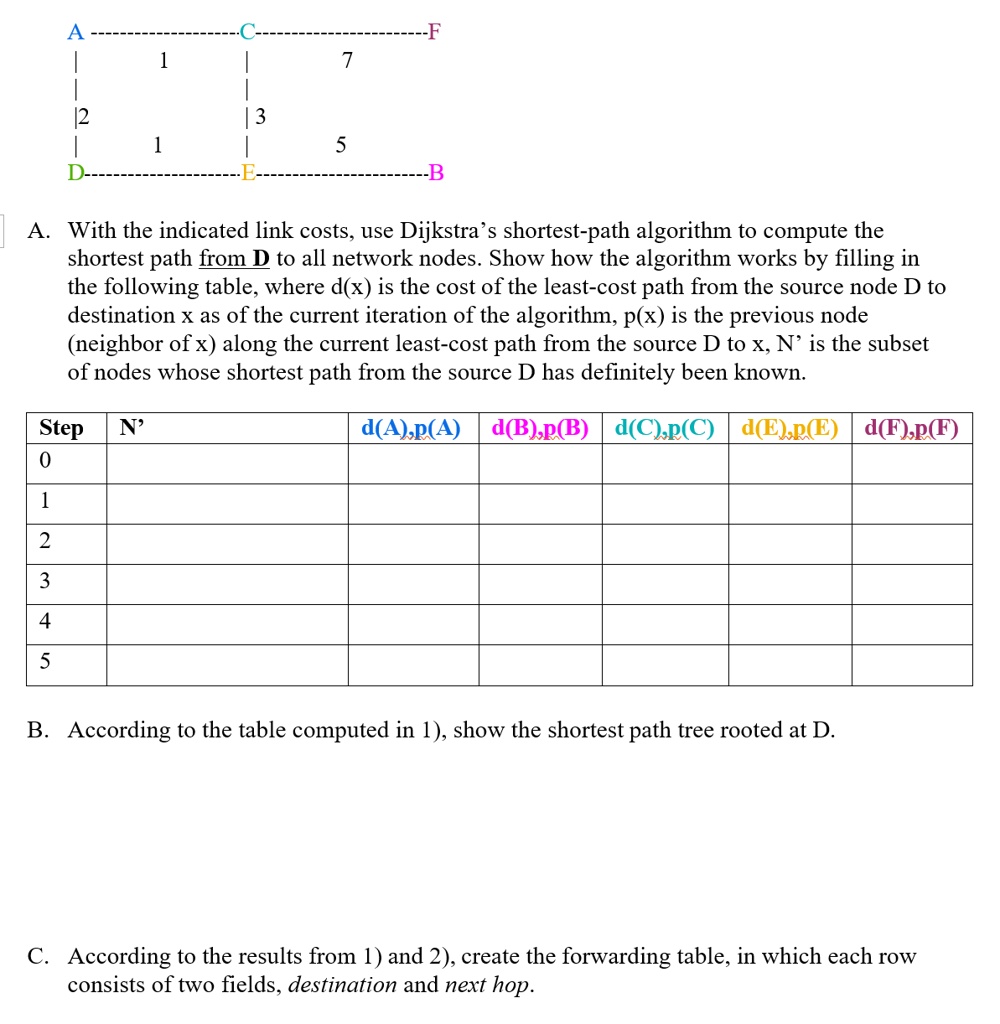
A. With the indicated link costs, use Dijkstra's shortest-path algorithm to compute the
shortest path from D to all network nodes. Show how the algorithm works by filling in
the following table, where $d(x)$ is the cost of the least-cost path from the source node D to
destination x as of the current iteration of the algorithm, $p(x)$ is the previous node
(neighbor of x) along the current least-cost path from the source D to x, N' is the subset
of nodes whose shortest path from the source D has definitely been known.
Step
N'
d(A),p(A) d(B),p(B) d(C),p(C) d(E),p(E) d(F),p(F)
0
1
2
3
4
5
B. According to the table computed in 1), show the shortest path tree rooted at D.
C. According to the results from 1) and 2), create the forwarding table, in which each row
consists of two fields, destination and next hop.