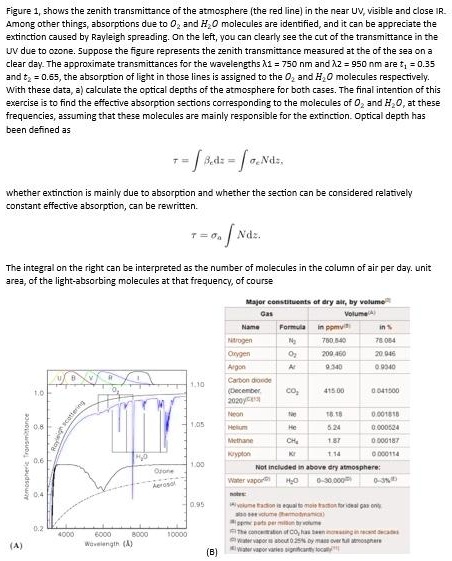
Figure 1, shows the zenith transmittance of the atmosphere (the red line) in the near UV, visible and close IR.
Among other things, absorptions due to O? and H?O molecules are identified, and it can be appreciate the
extinction caused by Rayleigh spreading. On the left, you can clearly see the cut of the transmittance in the
UV due to ozone. Suppose the figure represents the zenith transmittance measured at the of the sea on a
clear day. The approximate transmittances for the wavelengths 11 = 750 nm and 12 = 950 nm are t? = 0.35
and t? = 0.65, the absorption of light in those lines is assigned to the O? and H?O molecules respectively.
With these data, a) calculate the optical depths of the atmosphere for both cases. The final intention of this
exercise is to find the effective absorption sections corresponding to the molecules of O? and H?O, at these
frequencies, assuming that these molecules are mainly responsible for the extinction. Optical depth has
been defined as
$\tau = \int \sigma_a dz = \int \sigma_a N dz$.
whether extinction is mainly due to absorption and whether the section can be considered relatively
constant effective absorption, can be rewritten.
$\tau = \sigma_a \int N dz$.
The integral on the right can be interpreted as the number of molecules in the column of air per day. unit
area, of the light-absorbing molecules at that frequency, of course