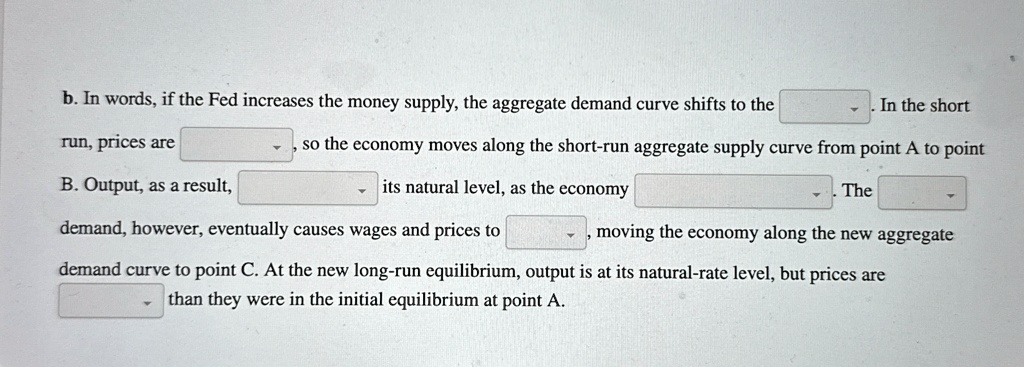
b. In words, if the Fed increases the money supply, the aggregate demand curve shifts to the $\boxed{right}$. In the short run, prices are $\boxed{higher}$, so the economy moves along the short-run aggregate supply curve from point A to point $\boxed{B}$.
B. Output, as a result, $\boxed{increases}$ its natural level, as the economy $\boxed{moves}$ . The $\boxed{higher}$ demand, however, eventually causes wages and prices to $\boxed{rise}$, moving the economy along the new aggregate demand curve to point C. At the new long-run equilibrium, output is at its natural-rate level, but prices are $\boxed{higher}$ than they were in the initial equilibrium at point A.