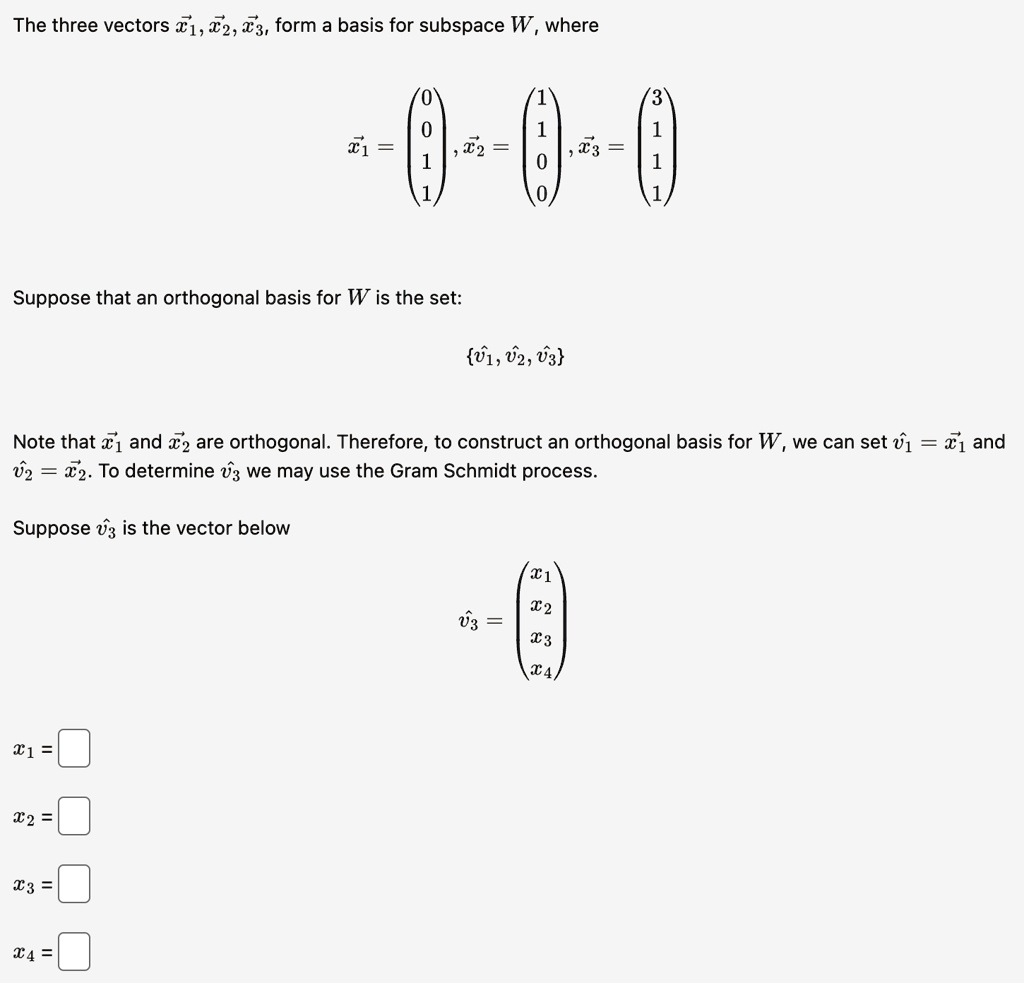
The three vectors \(\vec{x}_1, \vec{x}_2, \vec{x}_3\) form a basis for subspace W, where
\(\vec{x}_1 = \begin{pmatrix} 0 \ 1 \ 1 \ \end{pmatrix}, \vec{x}_2 = \begin{pmatrix} 1 \ 1 \ 0 \ \end{pmatrix}, \vec{x}_3 = \begin{pmatrix} 3 \ 1 \ 1 \ \end{pmatrix}\)
Suppose that an orthogonal basis for W is the set:
\(\{\vec{v}_1, \vec{v}_2, \vec{v}_3\}\)
Note that \(\vec{x}_1\) and \(\vec{x}_2\) are orthogonal. Therefore, to construct an orthogonal basis for W, we can set \(\vec{v}_1 = \vec{x}_1\) and
\(\vec{v}_2 = \vec{x}_2\). To determine \(\vec{v}_3\) we may use the Gram Schmidt process.
Suppose \(\vec{v}_3\) is the vector below
\(\vec{v}_3 = \begin{pmatrix} x_1 \ x_2 \ x_3 \ x_4 \ \end{pmatrix}\)
\(x_1 = \square\)
\(x_2 = \square\)
\(x_3 = \square\)
\(x_4 = \square\)