AnyLogo supplies firms with apparel containing their logo to be used for promotional
purposes. AnyLogo has three enterprise customers: IBM, HP, and Dell. During the
holiday season, the logos are adorned with a Christmas motif. Demand from each firm
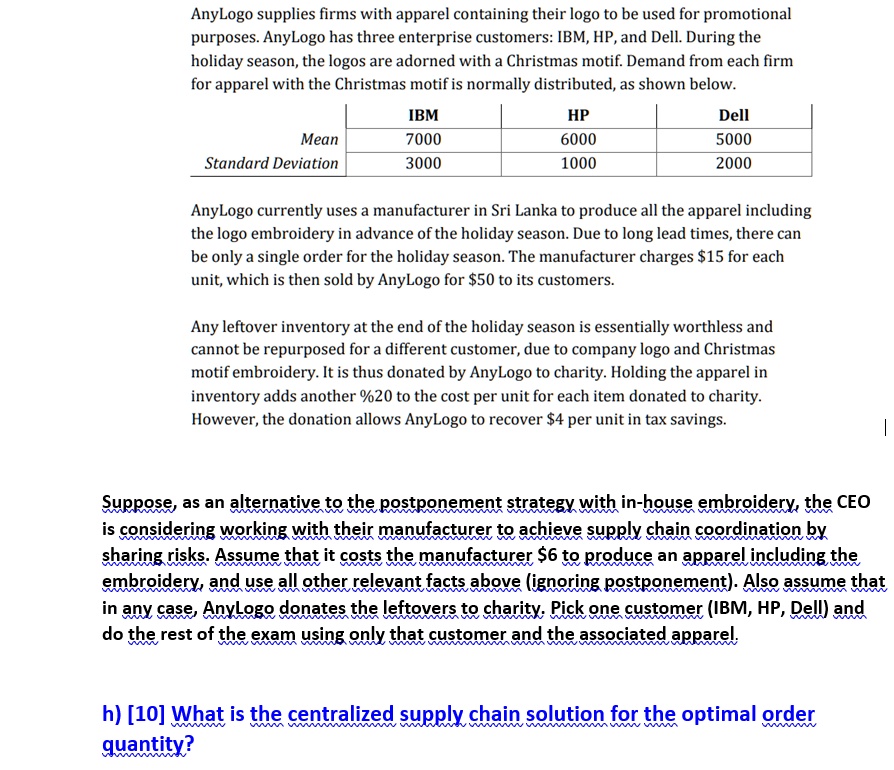
for apparel with the Christmas motif is normally distributed, as shown below.
Mean
IBM
7000
Standard Deviation
3000
HP
6000
1000
Dell
5000
2000
AnyLogo currently uses a manufacturer in Sri Lanka to produce all the apparel including
the logo embroidery in advance of the holiday season. Due to long lead times, there can
be only a single order for the holiday season. The manufacturer charges $15 for each
unit, which is then sold by AnyLogo for $50 to its customers.
Any leftover inventory at the end of the holiday season is essentially worthless and
cannot be repurposed for a different customer, due to company logo and Christmas
motif embroidery. It is thus donated by AnyLogo to charity. Holding the apparel in
inventory adds another %20 to the cost per unit for each item donated to charity.
However, the donation allows AnyLogo to recover $4 per unit in tax savings.
Suppose, as an alternative to the postponement strategy with in-house embroidery, the CEO
is considering working with their manufacturer to achieve supply chain coordination by
sharing risks. Assume that it costs the manufacturer $6 to produce an apparel including the
embroidery, and use all other relevant facts above (ignoring postponement). Also assume that
in any case, AnyLogo donates the leftovers to charity. Pick one customer (IBM, HP, Dell) and
do the rest of the exam using only that customer and the associated apparel.
ww
wwwwwwwwwwwwwwww
wwwwwwwwwwwwwwwwwwwwwwwwwwww
www
h) [10] What is the centralized supply chain solution for the optimal order
quantity?