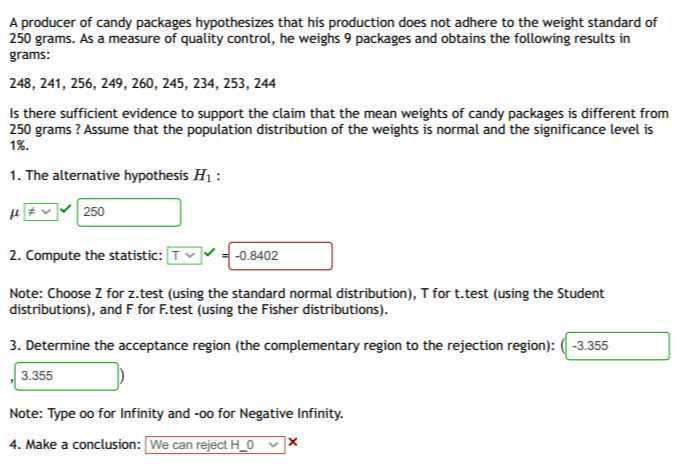
A producer of candy packages hypothesizes that his production does not adhere to the weight standard of 250 grams. As a measure of quality control, he weighs 9 packages and obtains the following results in grams:
\[
248,241,256,249,260,245,234,253,244
\]
Is there sufficient evidence to support the claim that the mean weights of candy packages is different from 250 grams? Assume that the population distribution of the weights is normal and the significance level is \( 1 \% \).
1. The alternative hypothesis \( H_{1} \) :
\[
\mu \neq v{ }^{2} 250
\]
2. Compute the statistic: \( \square \) \( -0.8402 \) \( = \) \( \square \)
Note: Choose Z for Z.test (using the standard normal distribution), T for t.test (using the Student distributions), and F for F.test (using the Fisher distributions).
3. Determine the acceptance region (the complementary region to the rejection region): ( -3.355 \( \square \)
3.355 \( \square \)
Note: Type 00 for Infinity and -oo for Negative Infinity.
4. Make a conclusion: We can reject \( \mathrm{H}_{-} 0 \quad \checkmark \times \)
\( \square \)