Ace - AI Tutor
Ask Our Educators
Textbooks
My Library
Flashcards
Scribe - AI Notes
Notes & Exams
Download App
kristin rosado

kristin r.

Divider

Questions asked

BEST MATCH

At a certain temperature this reaction follows first-order kinetics with a rate constant of 0.00261sāˆ’1 : →H2CO3aq+H2OaqCO2aq Suppose a vessel contains H2CO3 at a concentration of 0.210M . Calculate the concentration of H2CO3 in the vessel 420. seconds later. You may assume no other reaction is important. Round your answer to 2 significant digits.

View Answer
divider
BEST MATCH

Practice assigning oxidation numbers for the main atom in these acids. The oxidation number of S in H2SO4 is Blank 1 Question 2 +1+2+3+4+5+6+7+8 . The oxidation number of S in H2SO3 is Blank 2 Question 2 +1+2+3+4+5+6+7+8 . The oxidation number of N in HNO3 is Blank 3 Question 2 +1+2+3+4+5+6+7+8 . The oxidation number of N in HNO2 is Blank 4 Question 2 +1+2+3+4+5+6+7+8 .

View Answer
divider
BEST MATCH

Question 6 - Chapter 1 Quiz - Extra Credit - Connect mheducation.com/ext/map/index.html?_con=con\&external_browser=0\&launchUrl=https\%253A\%252F\%252FIms.mheducation.com\%252Fmghmi.... Extra Credit Saved Help Save \& Exit Submit company reported total equity of \( \$ 155,000 \) at the beginning of the year. The company reported \( \$ 220,000 \) in revenues and 70,000 in expenses for the year. Liabilities at the end of the year totaled \( \$ 97,000 \). What are the total assets of the company at the d of the year?

View Answer
divider
BEST MATCH

2. Problem 3.4.9: $y'' - y' = -3$

View Answer
divider
BEST MATCH

Question 45 1 pts LO 79 Explain that a phenotype might be monogenic at the molecular level, but polygenc: 5 the organismal level. Do the principles discovered by Mendel for discontinuous traits also apply to the inheritoce of traits that exhibit continuous variation? No. Discontinuous traits are the result of multiple genes that have additive effects and be betariad continuous traits as defined by Mendel is the result of just a few lod. Yes. Quantitative traits have Mendelian expression Yes. The environmental factors that control continuous traits also control discontinuos trats according to Mendel's principles. Yes. Quantitative characteristics can be explained by additive effects of multiple goos bort te behavior of each gene can be determined by Mendel's principles. No. Continuous traits are controlled by both genes and the environment and, therfore verdes principles would not apply. Question 46

View Answer
divider
BEST MATCH

2. The pH scale is used to measure the acidity of a solution. Neutral pH is ____. A lower value on the pH scale means more _____. A higher value on the pH scale means more _____. 3. The pH scale is logarithmic, and the number for pH actually represents the negative power of 10 for ____.

View Answer
divider
BEST MATCH

18. Suppose that some country had an adult population of about 59 million, a labor-force participation rate of 72.9 percent, and an unemployment rate of 2.3 percent. How many people were employed?a. 1.0 millionb. 42.0 millionC. 59 milliond. 137.2 million

View Answer
divider
BEST MATCH

ln Q = 4.29 - 1.38 ln P Percentage price change needed in order to boost revenues by $50,000: 6.7

View Answer
divider
BEST MATCH

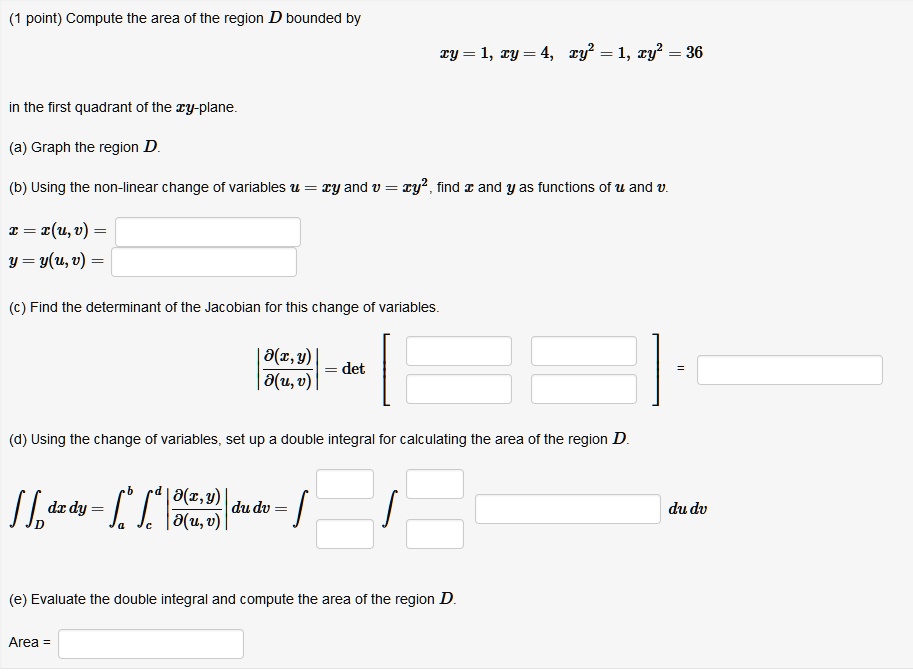
(1 point) Compute the area of the region D bounded by $\ xy = 1, xy = 4, xy^2 = 1, xy^2 = 36$ in the first quadrant of the $xy$-plane. (a) Graph the region D. (b) Using the non-linear change of variables $u = xy$ and $v = xy^2$, find $x$ and $y$ as functions of $u$ and $v$. $x = x(u, v) = $ $y = y(u, v) = $ (c) Find the determinant of the Jacobian for this change of variables. $\frac{\partial(x, y)}{\partial(u, v)} = det$ (d) Using the change of variables, set up a double integral for calculating the area of the region D. $\iint_D dx\ dy = \int_a^b \int_c^d \frac{\partial(x, y)}{\partial(u, v)} du\ dv = $ (e) Evaluate the double integral and compute the area of the region D. Area =
View Answer
divider
BEST MATCH

QUESTION 19 Give as good a big-O estimate as possible for the following function. $(n\log(n) + n^2)(n^3 + 2)$ a. $O(n\log(n))$ b. $O(n^3)$ c. $O(n^5)$ d. $O(n^2)$

View Answer
divider