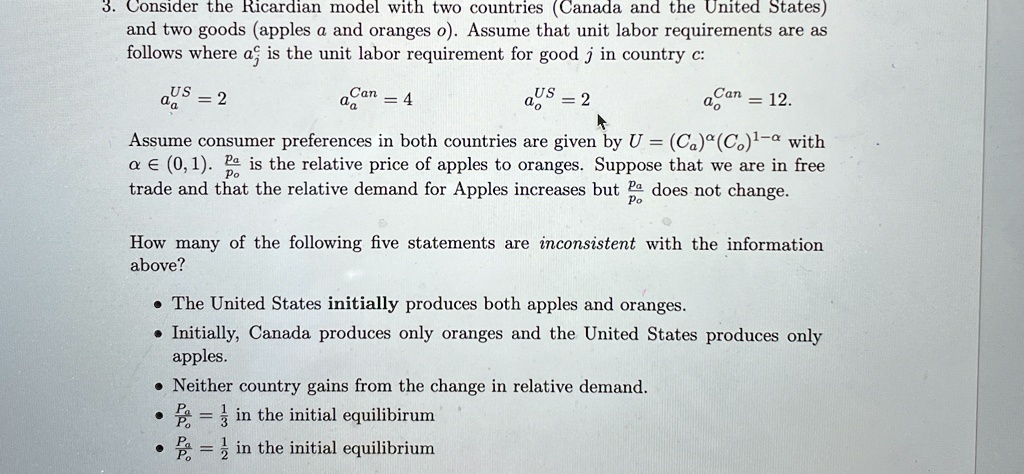
3. Consider the Ricardian model with two countries (Canada and the United States) and two goods (apples a and oranges o). Assume that unit labor requirements are as follows where $a_j^c$ is the unit labor requirement for good j in country c:
$a_a^{US} = 2$
$a_a^{Can} = 4$
$a_o^{US} = 2$
$a_o^{Can} = 12.$
Assume consumer preferences in both countries are given by $U = (C_a)^\alpha (C_o)^{1-\alpha}$ with $\alpha \in (0, 1)$. $\frac{P_a}{P_o}$ is the relative price of apples to oranges. Suppose that we are in free trade and that the relative demand for Apples increases but $\frac{P_a}{P_o}$ does not change.
How many of the following five statements are inconsistent with the information above?
• The United States initially produces both apples and oranges.
• Initially, Canada produces only oranges and the United States produces only apples.
• Neither country gains from the change in relative demand.
$\frac{P_a}{P_o} = \frac{1}{3}$ in the initial equilibrium
$\frac{P_a}{P_o} = \frac{1}{2}$ in the initial equilibrium