Ace - AI Tutor
Ask Our Educators
Textbooks
My Library
Flashcards
Scribe - AI Notes
Notes & Exams
Download App
kristin stone

kristin s.

Divider

Questions asked

BEST MATCH

Given the vertex (5,-4) and point (7,-16) of a parabola: calculate the concavity a and determine whether this parabola is concave up or concave down. Find the equation of this parabola and find the y-intercept.

View Answer
divider
BEST MATCH

Problem 1. (40 POINTS) Consider the Solow growth model with constant population ($\frac{\dot{L}}{L} = 0$) and with technology progress ($\frac{\dot{A}}{A} = g$). a) Define the steady state condition using one equation. Represent it graphically. b) Show the effects of a decrease in the saving rate $s$ and an increase in the depreciation rate of capital $\delta$ in two separate graphs. Briefly describe how the growth rates of capital and output per effective labor (i.e. $g_k$ and $g_y$) change during two adjustment processes? c) Assume the production function $Y = K^{0.5}(AL)^{0.5}$, $\delta = 0.05$, and $g = 0.02$. If per effective labor production is 10, what is the equilibrium value of $s$?

View Answer
divider
BEST MATCH

Fiscal policy is conducted by elected officials. concerns government spending and taxes. concerns the money supply and interest rates. all of the above a and b above

View Answer
divider
BEST MATCH

Select the option that best describes the trend in halogen reactivity. A. Halogen reactivity tends to increase from left to right across a period. B. Halogen reactivity tends to decrease from left to right across a period. C. Halogen reactivity tends to increase from top to bottom down a group. D. Halogen reactivity tends to decrease from top to bottom down a group. E. All halogens are reactive and there is no discernible trend.

View Answer
divider
BEST MATCH

Lesson 1.1: What Does Scripture Do? • Divine Revelation is communicated through A. words and deeds. B. visions and prophecies.

View Answer
divider
BEST MATCH

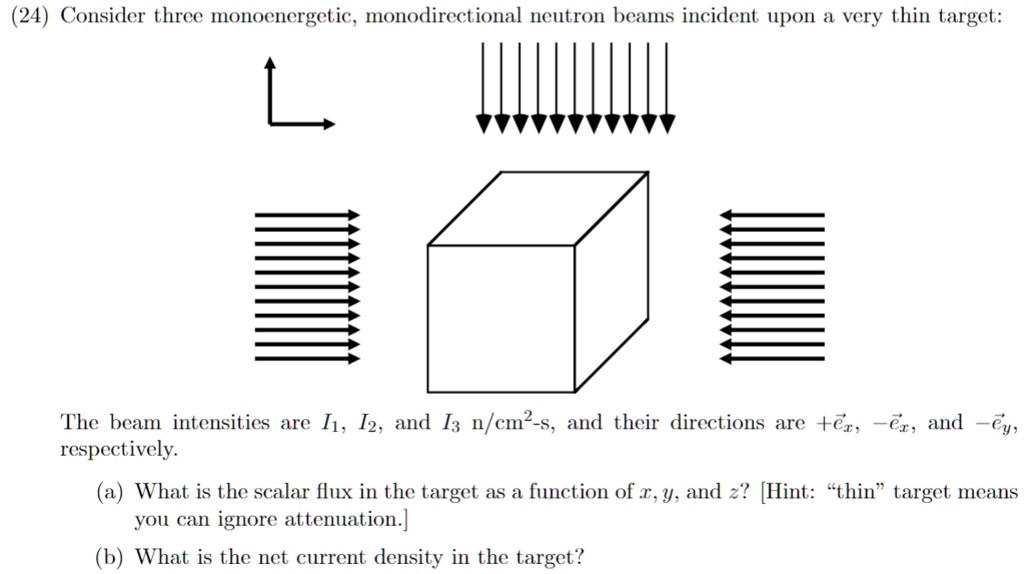
(24) Consider three monoenergetic, monodirectional neutron beams incident upon a very thin target: The beam intensities are $I_1$, $I_2$, and $I_3$ n/cm$^2$-s, and their directions are $+\vec{e_x}$, $-\vec{e_x}$, and $-\vec{e_y}$, respectively. (a) What is the scalar flux in the target as a function of $x$, $y$, and $z$? [Hint: \"thin\" target means you can ignore attenuation.] (b) What is the net current density in the target?
View Answer
divider
BEST MATCH

Question 4 [26 marks] 4.1. Assess the importance of multifactor authentication (MFA) in enhancing account security by providing examples of different authentication factors and their strengths and weaknesses. (14 marks)

View Answer
divider
BEST MATCH

Dutch microbiologist Martinus Beijerinck introduced the most common of these methods, called simply . Enrichment cultures use a selective medium and are designed to increase very small numbers of a chosen microbe to observable levels.

View Answer
divider
BEST MATCH

Answer: To solve this problem, we can use the formula for calculating the pH of a solution: pH = -log[H+] First, we need to calculate the total moles of Hâ‚‚SO4 in the mixture. Then, we can use the total moles to find the concentration of H+ ions in the solution, and finally, use the concentration to calculate the pH. Step 1: Calculate the moles of Hâ‚‚SO4 in each solution Moles = (volume in liters) x (molarity) Moles of Hâ‚‚SO4 in the first solution = 0.04143 L x 0.516 mol/L Moles of Hâ‚‚SO4 in the second solution = 0.15566 L x 1.469 mol/L Step 2: Calculate the total moles of Hâ‚‚SO4 Total moles = moles from first solution + moles from second solution Step 3: Calculate the total volume of the mixture Total volume = volume of first solution + volume of second solution Step 4: Calculate the concentration of H+ ions in the mixture Concentration = total moles / total volume Step 5: Calculate the pH pH = -log(concentration) By following these steps, we can find the pH of the resulting mixture.

View Answer
divider
BEST MATCH

Upon what specific assumptions is this production possibilities curve based? (Click to select) b. If the economy is at point C, what is the (opportunity) cost of producing two more automobiles? forklifts What is the (opportunity) cost of six more forklifts? automobiles Which characteristic of the production possibilities curve reflects the law of increasing opportunity costs: its shape or its length? (Click to select) c. If the economy characterized by this production possibilities table and curve is producing 3 automobiles and 20 forklifts, what could you conclude about its use of its available resources? The economy is (Click to select) its available resources. d. Is production at a point outside the production possibilities curve currently possible? (Click to select)

View Answer
divider