Ace - AI Tutor
Ask Our Educators
Textbooks
My Library
Flashcards
Scribe - AI Notes
Notes & Exams
Download App
kristine odom

kristine o.

Divider

Questions asked

BEST MATCH

Generate and test two SQL queries for each of the following tasks: a) the SQL statement needed to perform the stated task with the traditional approach(using the WHERE clause), b) the SQL statement needed to perform the stated task with the JOIN keyword. Apply table aliases in all queries. 5. Determine the profit of each book sold to Jake Lucas, using the actual price the customer paid (not the book's regular retail price). Sort the results by order date. If more than one book was ordered, sort the results by profit amount in descending order. You need to use four tables: customers, orders, orderitems, and books (15 points). Because of the complexity of this question, one correct SQL statement can get the full points. If you provide the second correct statement, I will give you 5 extra points. 7. What gift will a customer who orders the book Shortest Poems receive? Use the actual book retail value to determine the gift. You need to use two tables: books and promotion (15 points). In addition to the SQL statements, please submit a snapshot of the result you got when you run each of the SQL statements.

View Answer
divider
BEST MATCH

Consider the following sentence: “The computer is running.” Which of the following statements is true? a. It is grammatically incorrect. b. It can have more than one surface (syntax) structure. c. It can have more than one deep (semantic) structure. d. It violates bottom-up processing

View Answer
divider
BEST MATCH

(1 point) Consider the initial value problem $my'' + cy' + ky = F(t)$, $y(0) = 0$, $y'(0) = 0$ modeling the motion of a spring-mass-dashpot system initially at rest and subjected to an applied force $F(t)$, where the unit of force is the Newton (N). Assume that $m = 2$ kilograms, $c = 8$ kilograms per second, $k = 80$ Newtons per meter, and $F(t) = 30 \sin(6t)$ Newtons. a. Solve the initial value problem. y(t) = help (formulas) b. Determine the long-term behavior of the system. Is $\lim_{t \to \infty} y(t) = 0$? If it is, enter zero. If not, enter a function that approximates y(t) for very large positive values of t. For very large positive values of t, $y(t) \approx$ help (formulas)

View Answer
divider
BEST MATCH

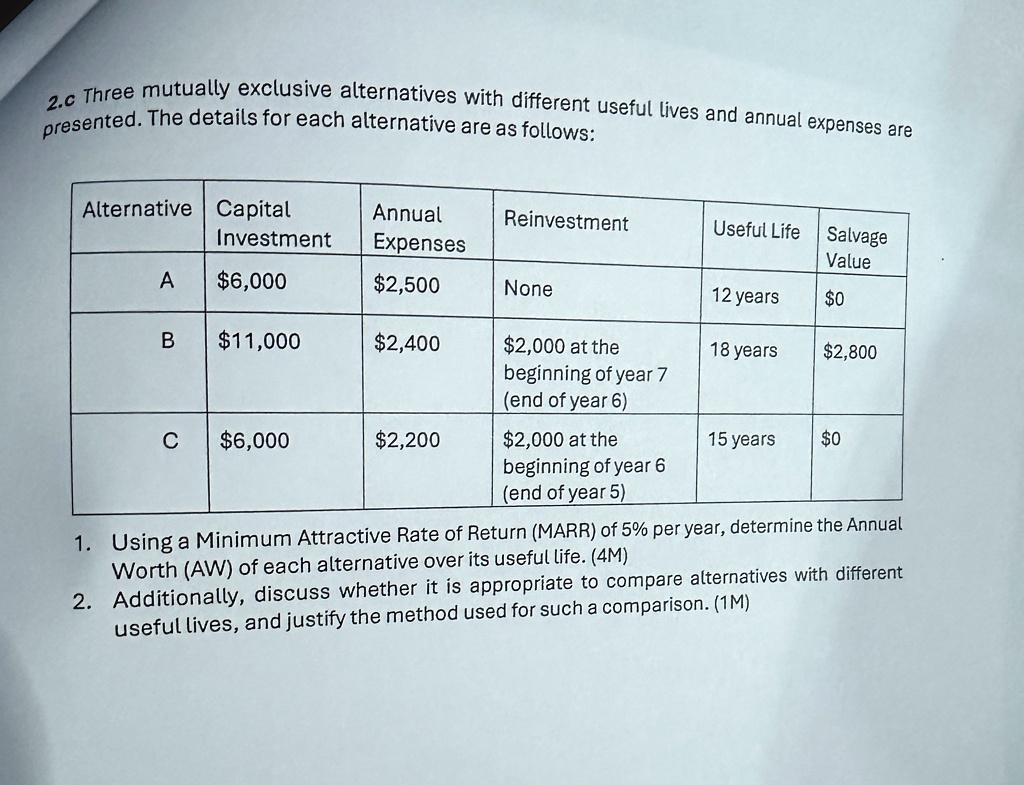
2.c Three mutually exclusive alternatives with different useful lives and annual expenses are presented. The details for each alternative are as follows: Alternative Capital Investment Annual Expenses Reinvestment Useful Life Salvage Value A $6,000 $2,500 None 12 years $0 B $11,000 $2,400 $2,000 at the beginning of year 7 (end of year 6) 18 years $2,800 C $6,000 $2,200 $2,000 at the beginning of year 6 (end of year 5) 15 years $0 1. Using a Minimum Attractive Rate of Return (MARR) of 5% per year, determine the Annual Worth (AW) of each alternative over its useful life. (4M) 2. Additionally, discuss whether it is appropriate to compare alternatives with different useful lives, and justify the method used for such a comparison. (1M)
View Answer
divider
BEST MATCH

Fasting blood sugar (FBS) levels would be diagnostic tool in determing the presence of diabetes insipidus. O True O False

View Answer
divider
BEST MATCH

Which of the following is not an example of observational learning? O a puppy watching its mother drink water out of the toilet O a cat watching tennis on television and following the ball with its head O a boy watching others play on the swings and then doing it himself O a dolphin watching other members of its pod hunt fish

View Answer
divider
BEST MATCH

?? Moving to another question will save this response. Question 57 What is the first step in the Reasoned Decision-Making Model? a. Identify the dilemma b. Test the values c. Consult the codes d. Consider the laws

View Answer
divider
BEST MATCH

Promotes regulatory of bowel movement increases satiety slows the rising blood sugar after meals are all functions of what

View Answer
divider
BEST MATCH

A saline solution contains 0.800 g of NaCl (molar mass = 58.55 g/mol) in 129 mL of solution. Calculate the concentration of NaCl in this solution, in units of molarity. Express the concentration in molarity to three significant figures.

View Answer
divider
BEST MATCH

\left(0.040 \frac{g \cdot m^2}{s^2}\right) \cdot \boxed{?} = ? \frac{kg \cdot m^2}{s^2}

View Answer
divider