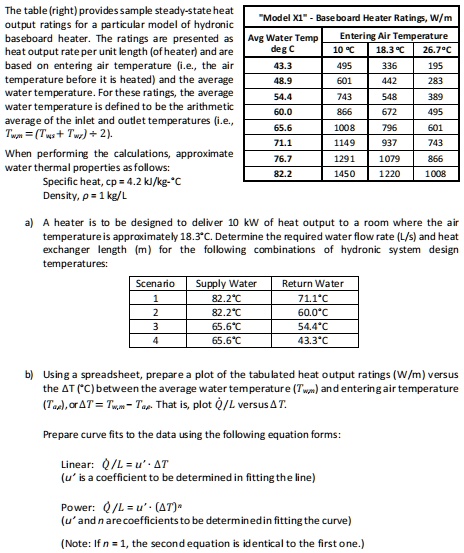
The table (right) provides sample steady-state heat
output ratings for a particular model of hydronic
baseboard heater. The ratings are presented as
heat output rate per unit length (of heater) and are
based on entering air temperature (i.e., the air
temperature before it is heated) and the average
water temperature. For these ratings, the average
water temperature is defined to be the arithmetic
average of the inlet and outlet temperatures (i.e.,
$T_{wm} = (T_{ws} + T_{wy}) \div 2)$.
When performing the calculations, approximate
water thermal properties as follows:
Specific heat, $c_p = 4.2 \text{ kJ/kg-}^\circ C$
Density, $\rho = 1 \text{ kg/L}$
a) A heater is to be designed to deliver 10 kW of heat output to a room where the air
temperature is approximately 18.3$^\circ$C. Determine the required water flow rate (L/s) and heat
exchanger length (m) for the following combinations of hydronic system design
temperatures:
Scenario Supply Water Return Water
1 82.2$^\circ$C 71.1$^\circ$C
2 82.2$^\circ$C 60.0$^\circ$C
3 65.6$^\circ$C 54.4$^\circ$C
4 65.6$^\circ$C 43.3$^\circ$C
b) Using a spreadsheet, prepare a plot of the tabulated heat output ratings (W/m) versus
the $\Delta T$ ($^\circ$C) between the average water temperature ($T_{wm}$) and entering air temperature
($T_{ap}$), or $\Delta T = T_{wm} - T_{ap}$. That is, plot $Q/L$ versus $\Delta T$.
Prepare curve fits to the data using the following equation forms:
Linear: $Q/L = u' \Delta T$
($u'$ is a coefficient to be determined in fitting the line)
Power: $Q/L = u' (\Delta T)^n$
($u'$ and $n$ are coefficients to be determined in fitting the curve)
(Note: If $n = 1$, the second equation is identical to the first one.)