Ace - AI Tutor
Ask Our Educators
Textbooks
My Library
Flashcards
Scribe - AI Notes
Notes & Exams
Download App
kristy moliner

kristy m.

Divider

Questions asked

BEST MATCH

How to write Effects of Community Service Projects into a problem statement

View Answer
divider
BEST MATCH

7. The following coupling reaction gave the major product 1, the minor product 2 was also observed. Please draw the mechanism to explain the formation of both products 1 and 2 (10 points) Br t-Bu Ph Ph MgBr + NiCl$_2$(PPh$_3$)$_2$ THF, rt Ph 1 2 t-Bu 80% t-Bu 20%

View Answer
divider
BEST MATCH

does normalization place any constraint on the storage of data in physical form or on its processing performance

View Answer
divider
BEST MATCH

Exercise 3. a) Show that for all integers $n, k \in \mathbb{Z}$, if $7 \nmid n$ then $7 \mid (n^{6k} - 1)$. b) Show that for any integer $n \in \mathbb{Z}$, one has $42 \mid (n^7 - n)$.

View Answer
divider
BEST MATCH

Discuss the role of the United States Department of Treasury, including the Internal Revenue Service, in the implementation and regulation of federal tax law.

View Answer
divider
BEST MATCH

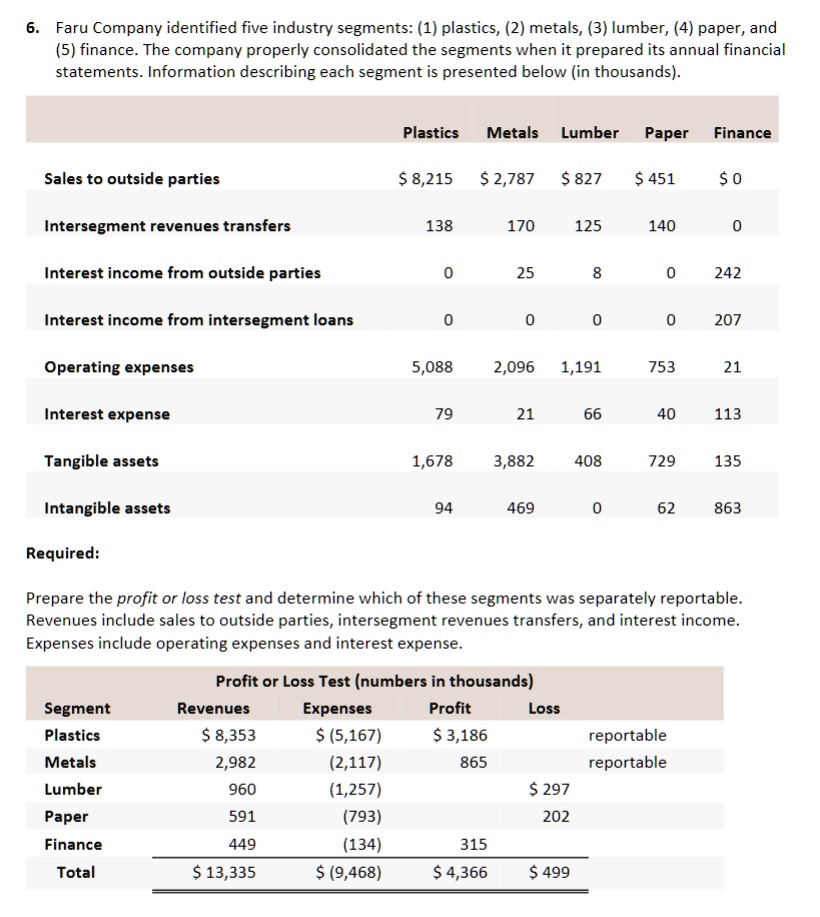
Need a breakdown of how the answer was determined. 5. Faru Company identified five industry segments: (1) plastics, (2) metals, (3) lumber, (4) paper, and (5) finance. The company properly consolidated the segments when it prepared its annual financial statements. Information describing each segment is presented below (in thousands): Plastics Sales to outside parties: $8,215 Intersegment revenues transfers: 138 Interest income from outside parties: 0 Interest income from intersegment loans: 0 Operating expenses: 5,088 Interest expense: 79 Tangible assets: 1,678 Intangible assets: 94 Metals Sales to outside parties: $2,787 Intersegment revenues transfers: 170 Interest income from outside parties: 25 Interest income from intersegment loans: 0 Operating expenses: 2,096 Interest expense: 21 Tangible assets: 3,882 Intangible assets: 469 Lumber Sales to outside parties: $827 Intersegment revenues transfers: 125 Interest income from outside parties: 8 Interest income from intersegment loans: 0 Operating expenses: 1,191 Interest expense: 66 Tangible assets: 408 Intangible assets: 0 Paper Sales to outside parties: $451 Intersegment revenues transfers: 140 Interest income from outside parties: 0 Interest income from intersegment loans: 0 Operating expenses: 753 Interest expense: 40 Tangible assets: 729 Intangible assets: 62 Finance Sales to outside parties: $0 Intersegment revenues transfers: 0 Interest income from outside parties: 242 Interest income from intersegment loans: 207 Operating expenses: 21 Interest expense: 113 Tangible assets: 135 Intangible assets: 863 Required: Prepare the profit or loss test and determine which of these segments was separately reportable. Revenues include sales to outside parties, intersegment revenues transfers, and interest income. Expenses include operating expenses and interest expense. Profit or Loss Test (numbers in thousands) Segment: Plastics Revenues: $8,353 Expenses: $(5,167) Profit: $3,186 Reportable Segment: Metals Revenues: $2,982 Expenses: $(2,117) Profit: $865 Reportable Segment: Lumber Revenues: $960 Expenses: $(1,257) Profit: $297 Segment: Paper Revenues: $591 Expenses: $(793) Loss: $(202) Segment: Finance Revenues: $449 Expenses: $(134) Profit: $315 Total Revenues: $13,335 Expenses: $(9,468) Profit: $4,366 Loss: $499
View Answer
divider
BEST MATCH

Guide Questions: 1. What are common in the four pictures? 2. Millions of years ago, the land masses in each picture were once connected. What do you think is happening to the earth's crust in those pictures? 3. If this event continues for millions of years, what do you think will be the effect on the crust?

View Answer
divider
BEST MATCH

Statement A: Empirical finance stipulates that riskier stocks must compensate investors in terms of higher expected returns, but the empirical challenge is to identify the relevant factors determining the riskiness of stocks. CAPM, for instance, only acknowledges the sensitivity (exposure) to market risk, while the Fama and French (1993) model generalized the definition of risk, adding the market value (size) of the company and the book-to-market ratio as systematic risk factors. Statement B: Prospective investors may exhibit a tendency to misperceive the risk-return tradeoff. Riskier stocks are expected to generate low returns, and vice versa, safer stocks are expected to bring high returns. Affective attitudes negatively correlate with the perceived riskiness of familiar (DAX30) stocks, while positively correlating with the expected returns. Past returns also negatively link with the perceived riskiness of the stocks, while positively correlating with the expected return on the stock. Statement C: Surprisingly, the misperception of the risk-return correlation also reflects in the analysts' forecasts of the future return and riskiness of the DAX30 stocks. The analysts' return predictions for risky stocks are lower than their return predictions for relatively safe stocks. Only statement B is correct. Only statement A is correct. All three statements A, B, and C are correct. Statements B and C are correct. A is false. Statements A and B are correct. C is false.

View Answer
divider
BEST MATCH

1. Plot the following equation. $x^2 + y^2 = 9$ Use lhs equation to shift the variables to the left.

View Answer
divider
BEST MATCH

3. [20 points: (a) 5, (b) 15] For a 3 x 3 system of ODEs, $\vec{x}\,' = A\vec{x}$ where A is an 3 × 3 matrix, the general solution is given by $\vec{x}(t) = c_1\vec{x}_1(t) + c_2\vec{x}_2(t) + c_3\vec{x}_3(t)$ where $\vec{x}_1, \vec{x}_2, \vec{x}_3$ form a fundamental set of solutions (are solutions to ODE and linearly independent). (a) Suppose A has 3 simple eigenvalues, $\lambda_1, \lambda_2, \lambda_3$ with associated eigenvectors $\vec{v}_1, \vec{v}_2, \vec{v}_3$ respectively. Show that $\vec{x}_1 = e^{\lambda_1 t}\vec{v}_1$, $\vec{x}_2 = e^{\lambda_2 t}\vec{v}_2$, $\vec{x}_3 = e^{\lambda_3 t}\vec{v}_3$, form a fundamental set of solutions. (b) Using part (a), solve the following system of IVPs: $\vec{x}\,' = \begin{pmatrix} -2 & 1 & 0\\0 & 2 & 1\\0 & 1 & 2 \end{pmatrix} \vec{x}$, $\vec{x}(0) = \begin{pmatrix} -1\\7\\13 \end{pmatrix}$ Hint: Eigenvalues of the matrix will be distinct, real, and integers.

View Answer
divider