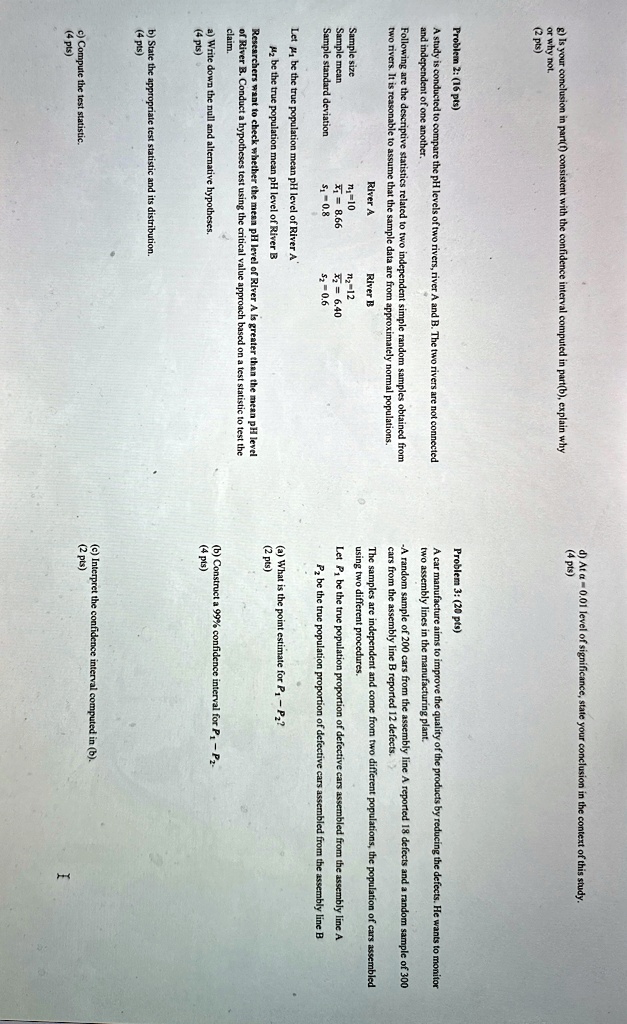
Problem 2: (16 pts)
A study is conducted to compare the pH levels of two rivers, river A and B. The two rivers are not connected
and independent of one another.
Following are the descriptive statistics related to two independent simple random samples obtained from
two rivers. It is reasonable to assume that the sample data are from approximately normal populations.
River A
River B
Sample size
n₁=10
12-12
Sample mean
X₁ = 8.66
2 = 6.40
Sample standard deviation
S₁=0.8
S2 = 0.6
Let ₁ be the true population mean pH level of River A
M₂ be the true population mean pH level of River B
Researchers want to check whether the mean pH level of River A is greater than the mean pH level
of River B. Conduct a hypotheses test using the critical value approach based on a test statistic to test the
claim.
a) Write down the null and alternative hypotheses.
(4 pts)
b) State the appropriate test statistic and its distribution.
(4 pts)
c) Compute the test statistic.
(4 pts)
Problem 3: (20 pts)
A car manufacture aims to improve the quality of the products by reducing the defects. He wants to monitor
two assembly lines in the manufacturing plant.
-A random sample of 200 cars from the assembly line A reported 18 defects and a random sample of 300
cars from the assembly line B reported 12 defects.
The samples are independent and come from two different populations, the population of cars assembled
using two different procedures.
Let P₁ be the true population proportion of defective cars assembled from the assembly line A
P₂ be the true population proportion of defective cars assembled from the assembly line B
(a) What is the point estimate for P1-P2?
(2 pts)
(b) Construct a 99% confidence interval for P1-P2
(4 pts)
(c) Interpret the confidence interval computed in (b).
(2 pts)
g) Is your conclusion in part(f) consistent with the confidence interval computed in part(b), explain why
or why not.
(2 pts)
d) At a 0.01 level of significance, state your conclusion in the context of this study.
(4 pts)