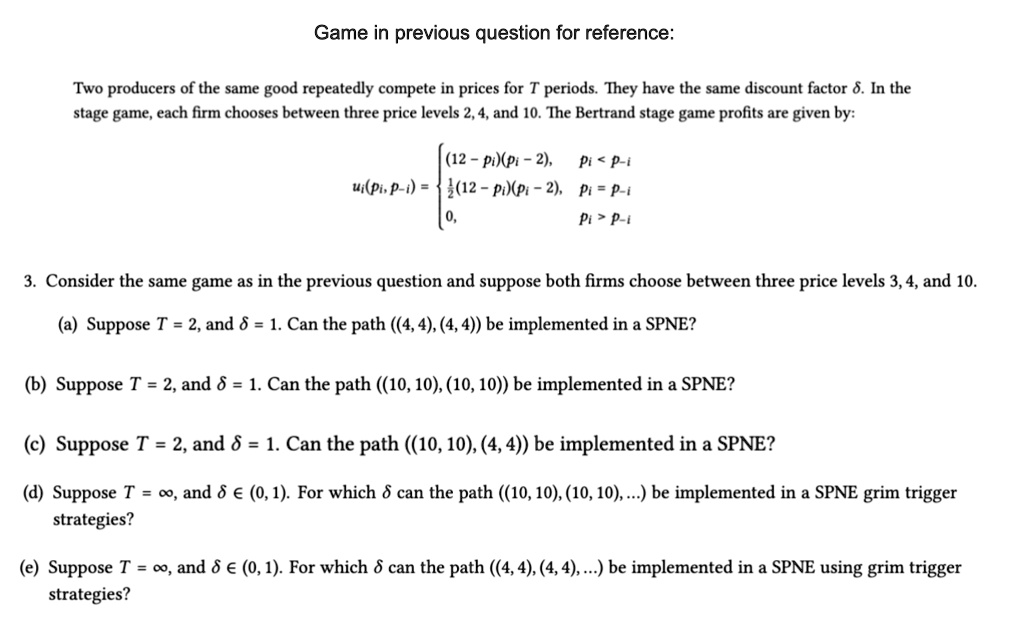
Game in previous question for reference:
Two producers of the same good repeatedly compete in prices for T periods. They have the same discount factor \(\delta\). In the
stage game, each firm chooses between three price levels 2, 4, and 10. The Bertrand stage game profits are given by:
\(u_i(p_i, p_{-i}) = \begin{cases} (12 - p_i)(p_i - 2), & p_i < p_{-i} \ \frac{1}{2}(12 - p_i)(p_i - 2), & p_i = p_{-i} \ 0, & p_i > p_{-i} \end{cases}\)
3. Consider the same game as in the previous question and suppose both firms choose between three price levels 3, 4, and 10.
(a) Suppose \(T = 2\), and \(\delta = 1\). Can the path ((4, 4), (4, 4)) be implemented in a SPNE?
(b) Suppose \(T = 2\), and \(\delta = 1\). Can the path ((10, 10), (10, 10)) be implemented in a SPNE?
(c) Suppose \(T = 2\), and \(\delta = 1\). Can the path ((10, 10), (4, 4)) be implemented in a SPNE?
(d) Suppose \(T = \infty\), and \(\delta \in (0, 1)\). For which \(\delta\) can the path ((10, 10), (10, 10), ...) be implemented in a SPNE grim trigger
strategies?
(e) Suppose \(T = \infty\), and \(\delta \in (0, 1)\). For which \(\delta\) can the path ((4, 4), (4, 4), ...) be implemented in a SPNE using grim trigger
strategies?