Ace - AI Tutor
Ask Our Educators
Textbooks
My Library
Flashcards
Scribe - AI Notes
Notes & Exams
Download App
kyle quir-s

kyle q.

Divider

Questions asked

BEST MATCH

A 54-year-old woman is diagnosed with delirium due to multiple etiologies. She exhibits signs of both alcohol withdrawal delirium and delirium secondary to hepatic encephalopathy. Which of the following is most appropriate for her management?

View Answer
divider
BEST MATCH

1. The calculated trend between the turnover for 2019 and 2020 is Answer %. Enter the amount, either negative (e.g., -5.67) or positive (e.g., 5.67), rounded to two decimals. The percentage sign should not be added to the answer. 2. The calculated rate of gross profit for 2020 is Answer %. Enter the amount, either negative (e.g., -5.67) or positive (e.g., 5.67), rounded to two decimals. The percentage sign should not be added to the answer. 3. The calculate net loss before the average for 2020 is R Answer. Enter a numerical number without spaces or commas for thousand separators (E.g 172224000). Do not add the denomination to the answer. 4. The calculate net loss after average (if applicable) for 2020 is R Answer Enter a numerical number without spaces or commas for thousand separators (E.g 172224000). Do not add the denomination to the answer.

View Answer
divider
BEST MATCH

Decreasing government spending \_\_\_\_\_ the price level and \_\_\_\_\_ equilibrium real GDP. A. increases; decreases B. increases; increases C. decreases; increases D. decreases; decreases

View Answer
divider
BEST MATCH

1. explain how to show that a decision problem is NP complete 2. discuss briefly how to prove an algorithm correction

View Answer
divider
BEST MATCH

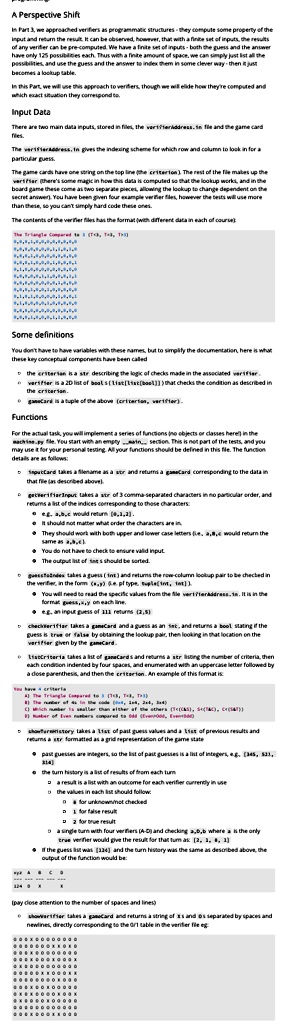
In Part 3, we approached verifiers as programmatic structures - they compute some property of the input and return the result. It can be observed, however, that with a finite set of inputs, the results of any verifier can be pre-computed. We have a finite set of inputs - both the guess and the answer have only 125 possibilities each. Thus with a finite amount of space, we can simply just list all the possibilities, and use the guess and the answer to index them in some clever way-then it just becomes a lookup table. In this Part, we will use this approach to verifiers, though we will elide how they're computed and which exact situation they correspond to. Input Data There are two main data inputs, stored in files, the verifierAddress. in file and the game card files. The verifieraddress. in gives the indexing scheme for which row and column to look in for a particular guess. The game cards have one string on the top line (the criterion). The rest of the file makes up the verifier (there's some magic in how this data is computed so that the lookup works, and in the board game these come as two separate pieces, allowing the lookup to change dependent on the secret answer). You have been given four example verifier files, however the tests will use more than these, so you can't simply hard code these ones. The contents of the verifier files has the format (with different data in each of course): The Tr sangle compared to a (Tc3, T*3, T>3) Some definitions You don't have to have variables with these names, but to simplify the documentation, here is what these key conceptual components have been called the criterion is a str describing the logic of checks made in the associated verifier. verifier is a 2D list of bool s(List[list(bool)]) that checks the condition as described in the criterion. ganeCard is a tuple of the above (criterion, verifier) Functions For the actual task, you will implement a series of functions (no objects or classes herel) in the machine.py file. You start with an empty .- section. This is not part of the tests, and you may use it for your personal testing. All your functions should be defined in this file. The function details are as follows: inputcard takes a filename as a str and returns a ganeCard corresponding to the data in that file (as described above). getverifierInput takes a str of 3 comma-separated characters in no particular order, and returns a list of the indices corresponding to those characters: e.g., a,b,c would return \theta ,1,2 It should not matter what order the characters are in. They should work with both upper and lower case letters (i.e., a,B,c would return the same as a,b,c. You do not have to check to ensure valid input. The output list of int s should be sorted. guesstoIndex takes a guess ( int) and retums the row-column lookup pair to be checked in the verifier, in the form ( x,y ) (i.e. pf type, tuple [int, int]). You will need to read the specific values from the file verifieraddress. in. It is in the format guess, x,y on each line. e.g., an input guess of 111 returns (2,5) checkverifier takes a ganeCard and a guess as an int, and returns a bool stating if the guess is true or false by obtaining the lookup pair, then looking in that location on the verifier given by the ganeCard. Listcriteria takes a list of ganecard s and returns a str listing the number of criteria, then each condition indented by four spaces, and enumerated with an uppercase letter followed by a close parenthesis, and then the criterion. An example of this format is: You have 4 criteria A) The Triangle Cospared to 3(T<3,T=3,T>3) B) The ramber of 4s in the code (0x4,1\times 4,2\times 4,3\times 4) D) Nurber of Even numbers compared to Odd (Evensodd, Evens0dd) showTurnHistory takes a tist of past guess values and a tist of previous results and returns a str formatted as a grid representation of the game state past guesses are integers, so the list of past guesses is a list of integers, e.g., [345, 521, 314] the turn history is a list of results of from each turn a result is a list with an outcome for each verifier currently in use the values in each list should follow: & for unknown/not checked 1 for false result 2 for true result a single turn with four verifiers ( A-D) and checking a,D,b where a is the only true verifier would give the result for that turm as: 2,1,8,1. If the guess list was [124] and the turn history was the same as described above, the output of the function would be: \table[[xyz,A,B,C,0],[124,0,x,,x]] (pay close attention to the number of spaces and line
View Answer
divider
BEST MATCH

Which confidence interval would lead you to Fail to Reject $H_0$? Test value: 10 Confidence Interval: 13.1 - 15.1 Test value: 10 Confidence Interval: 9.2 - 9.8 Test value: 5 Confidence Interval: 5.6 - 6.9 Test value: 5 Confidence Interval: 4.5 - 6.3

View Answer
divider
BEST MATCH

Where are words/ideas that often convey the most importance placed in the sentence? Group of answer choices End Middle Throughout Beginning

View Answer
divider
BEST MATCH

There are 6 questions (2 pages in total). Answer all of them. You can write answers on paper or can use any Word processing tool. Whatever you follow, please create one pdf and submit it to Canvas (corresponding homework portal). Q1. {Points: 2 + 4 = 6} Draw a block diagram of a home access network that operates on digital subscriber line (DSL) Briefly describe each element of DSL present in the diagram

View Answer
divider
BEST MATCH

Suppose that $f(\frac{\pi}{3}) = -3$ and $f'(\frac{\pi}{3}) = 8$, and let $g(x) = f(x)\sin x$ and $h(x) = \frac{\cos x}{f(x)}$. Answer the following questions. 1. Find $g'(\frac{\pi}{3})$. Answer: $g'(\frac{\pi}{3}) =$ 2. Find $h'(\frac{\pi}{3})$. Answer: $h'(\frac{\pi}{3}) =$ Note: You can earn partial credit on this problem. Preview My Answers Submit Answers You have attempted this problem 0 times. You have 3 attempts remaining. Email Instructor

View Answer
divider
BEST MATCH

The nurse in the pediatric unit is caring for a 6-month-old client. The nurse is reviewing the client's assessment data to prepare the client's plan of care. >Complete the diagram by dragging from the choices below to specify what condition the client is most likely experiencing, 2 actions the nurse should take to address that condition, and 2 parameters the nurse should monitor to assess the client's progress. Nurses' Notes 0800: Client admitted with increased irritability and a leaking gastrostomy feeding tube, which was placed 2 weeks ago for failure to thrive. The feeding tube insertion site, which is on the left side of the abdomen, is covered with a dressing that is saturated with old formula. On removal of the dressing, the skin surrounding the feeding tube site is erythematous and flaking. At the insertion site, a small amount of thick, yellow drainage is noted, and the feeding tube is loose. Peripheral pulses are weak; capillary refill is 3 seconds. Extremities are cool to the touch. Client is intermittently pulling at the tube and scratching at the site. Parent reports giving the client acetaminophen last night before bedtime, but the client was still intermittently waking and irritable throughout the night. Parent attempted to feed the client through the feeding tube 8 hours ago.Vital signs: temporal T 100.6F (38.1C,P 171,RR 42,BP 74/62,pulse oximetry reading 97% on room air.Parent has a history of a penicillin allergy. Action to Take Parameter to Monitor Condition Most Likely Experiencing Action to Take Parameter to Monitor Actions to Take Potential Conditions Parameters to Monitor change the site dressing refeeding syndrome request a wound consultation infection of the gastrostomy tube site skin integrity obtain an electrocardiogram (ECG). normal gastrostomy tube site findings feeding tolerance request a bolus of intravenous 0.9% sodium chloride (normal saline) intolerance to gastrostomy tube feedings vital signs every 30 minutes reassure the parent that the site findings are the normal progression of healing parent's ability to administer a tube feeding

View Answer
divider