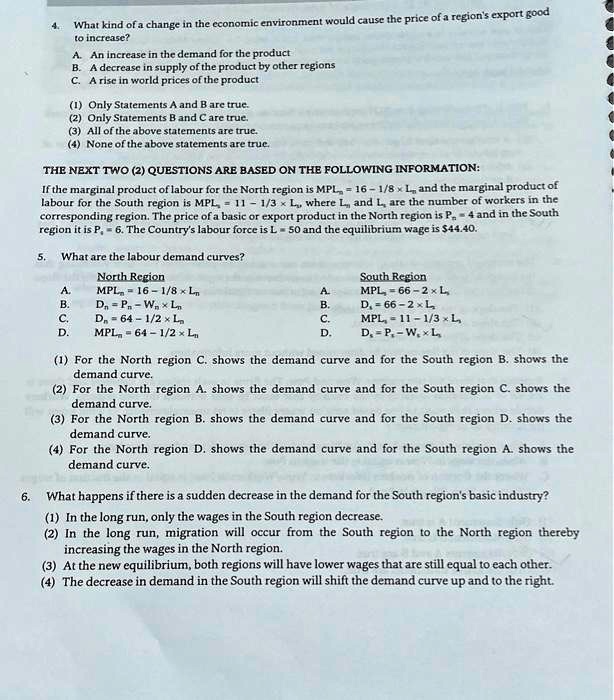
To increase:
A. An increase in the demand for the product
B. A decrease in supply of the product by other regions
C. A rise in world prices of the product
Only Statements A and B are true.
Only Statements B and C are true.
All of the above statements are true.
None of the above statements are true.
THE NEXT TWO (2) QUESTIONS ARE BASED ON THE FOLLOWING INFORMATION:
If the marginal product of labour for the North region is MPL = 16 - 1/8L and the marginal product of labour for the South region is MPL = 11 - 1/3L, where L and L are the number of workers in the corresponding region. The price of a basic or export product in the North region is P = 4 and in the South region it is P = -6. The country's labour force is L = 50 and the equilibrium wage is $44.40.
5. What are the labour demand curves?
North Region: MPL = 16 - 1/8L
D = Pn = W x L
D = 64 - 1/2L
MPL = 64 - 1/2L
South Region: MPL = 66 - 2L
D = 66 - 2L
MPL = 11 - 1/3L
D = P - W x L
A. B. C. D.
A.
C. D.
1. For the North region, C shows the demand curve and for the South region, B shows the demand curve.
2. For the North region, A shows the demand curve and for the South region, C shows the demand curve.
3. For the North region, B shows the demand curve and for the South region, D shows the demand curve.
4. For the North region, D shows the demand curve and for the South region, A shows the demand curve.
6. What happens if there is a sudden decrease in the demand for the South region's basic industry?
1. In the long run, only the wages in the South region decrease.
2. In the long run, migration will occur from the South region to the North region, thereby increasing the wages in the North region.
3. At the new equilibrium, both regions will have lower wages that are still equal to each other.
4. The decrease in demand in the South region will shift the demand curve up and to the right.