Given,
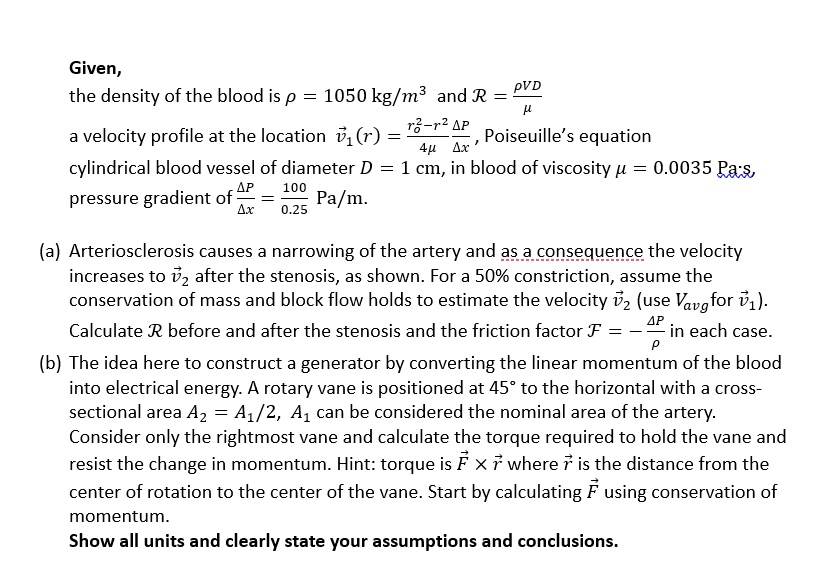
the density of the blood is $\rho = 1050 \text{ kg/m}^3$ and $R = \frac{\rho VD}{\mu}$
a velocity profile at the location $\vec{v}_1(r) = \frac{r^2 - r^2}{4\mu} \frac{\Delta P}{\Delta x}$, Poiseuille's equation
cylindrical blood vessel of diameter $D = 1 \text{ cm}$, in blood of viscosity $\mu = 0.0035 \text{ Pa s}$,
pressure gradient of $\frac{\Delta P}{\Delta x} = \frac{100}{0.25} \text{ Pa/m}$.
(a) Arteriosclerosis causes a narrowing of the artery and as a consequence the velocity
increases to $\vec{v}_2$ after the stenosis, as shown. For a 50% constriction, assume the
conservation of mass and block flow holds to estimate the velocity $\vec{v}_2$ (use $V_{avg}$ for $\vec{v}_1$).
Calculate R before and after the stenosis and the friction factor $F = \frac{\Delta P}{\rho}$ in each case.
(b) The idea here to construct a generator by converting the linear momentum of the blood
into electrical energy. A rotary vane is positioned at 45° to the horizontal with a cross-
sectional area $A_2 = A_1/2$, $A_1$ can be considered the nominal area of the artery.
Consider only the rightmost vane and calculate the torque required to hold the vane and
resist the change in momentum. Hint: torque is $\vec{F} \times \vec{r}$ where $\vec{r}$ is the distance from the
center of rotation to the center of the vane. Start by calculating $\vec{F}$ using conservation of
momentum.
Show all units and clearly state your assumptions and conclusions.