Ace - AI Tutor
Ask Our Educators
Textbooks
My Library
Flashcards
Scribe - AI Notes
Notes & Exams
Download App
lance whitney

lance w.

Divider

Questions asked

BEST MATCH

When you simplify the exponents of 106÷(1010)−2 to a base of 10, what is the exponent?

View Answer
divider
BEST MATCH

The organ that cannot function without glucose as an energy source is the

View Answer
divider
BEST MATCH

The volume V of a given mass of gas varies directly as the temperature T and inversely as the pressure P. If $V = 148.5 \text{ in.}^3$ when $T = 270^\circ$ and $P = 20 \text{lb/in.}^2$, what is the volume when $T = 160^\circ$ and $P = 10 \text{lb/in.}^2$? (Round to the nearest tenth.)

View Answer
divider
BEST MATCH

Reading from left to right, a sequence consists of 6 A’s, followed by 24 B’s, followed by 96 A’s. After the first n letters (from left to right), one letter has occurred twice as many times as the other letter. What is the sum of all the possible values of n?

View Answer
divider
BEST MATCH

def get_row(puzzle:str, row_num: int)-> str: """Return the puzzle located in the given row_num. >>> get_row('absd\ndcsa\ndhjf\n', 1) 'dcsa' >>> get_row('wbzd\ngwpsan\ngd\n', 0) 'wbzd' """ return

View Answer
divider
BEST MATCH

Choose a sketch of curves relating glycogen synthase reaction velocity to [ UDP -glucose], for the a form of the enzyme, in the presence and absence of glucose-6-phosphate.

View Answer
divider
BEST MATCH

Consider the statement, For all connected graphs G, if every vertex of G has even degree, then G has an Euler circuit. Note, you do not need to know what the terms used in the statement mean to complete this problem. What would the first line of a direct proof be? A. Let G be a connected graph and assume every vertex has even degree. B. Let G be a connected graph and assume it does not have an Euler circuit. C. Let G be a connected graph and assume at least one vertex has odd degree. D. Let G be a connected graph and assume it has an Euler circuit. E. Assume there is some connected graph that has all even degree vertices but does not contains an Euler circuit. What would the first line of a proof by contrapositive be? A. Assume there is some connected graph that has all even degree vertices but does not contains an Euler circuit. B. Let G be a connected graph and assume it has an Euler circuit. C. Let G be a connected graph and assume it does not have an Euler circuit. D. Let G be a connected graph and assume at least one vertex has odd degree. E. Let G be a connected graph and assume every vertex has even degree. What would the first line of a proof by contradiction be? A. Let G be a connected graph and assume every vertex has even degree. B. Let G be a connected graph and assume it does not have an Euler circuit. C. Let G be a connected graph and assume at least one vertex has odd degree. D. Let G be a connected graph and assume it has an Euler circuit. E. Assume there is some connected graph that has all even degree vertices but does not contains an Euler circuit.

View Answer
divider
BEST MATCH

1.1 Solve the following quadratic equation using the quadratic formula: $x^2 = 10x - 23$ 1.2 Solve this equation $x(x - 7) - 2 = 0$ using the graphical method. Evaluate the limit, if it exists 1.3 $\lim_{x\to -2} (14 - 6x + x^2)$ 1.4 Evaluate the following limit $\lim_{x\to -1} \frac{x^2 - x - 2}{x^2 - 2x - 3}$

View Answer
divider
BEST MATCH

Find the exact value of each of the remaining trigonometric functions of $\theta$. $\cos \theta = \frac{12}{13}$, $270^\circ < \theta < 360^\circ$

View Answer
divider
BEST MATCH

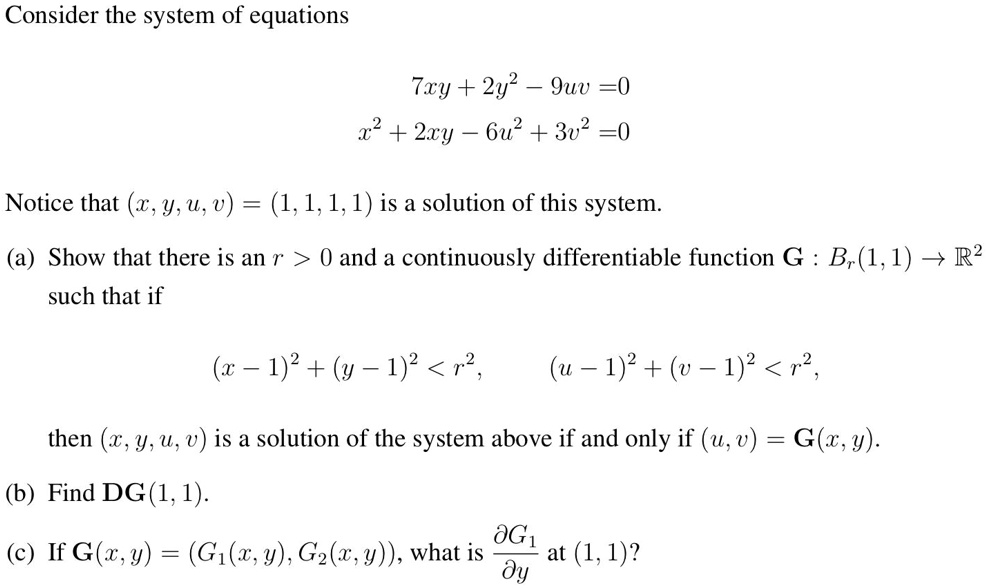
Consider the system of equations $7xy + 2y^2 - 9uv = 0$ $x^2 + 2xy - 6u^2 + 3v^2 = 0$ Notice that $(x, y, u, v) = (1, 1, 1, 1)$ is a solution of this system. (a) Show that there is an $r > 0$ and a continuously differentiable function $G: B_r(1, 1) \rightarrow \mathbb{R}^2$ such that if $(x - 1)^2 + (y - 1)^2 < r^2$, $(u - 1)^2 + (v - 1)^2 < r^2$, then $(x, y, u, v)$ is a solution of the system above if and only if $(u, v) = G(x, y)$. (b) Find $DG(1, 1)$. (c) If $G(x, y) = (G_1(x, y), G_2(x, y))$, what is $\frac{\partial G_1}{\partial y}$ at $(1, 1)$?
View Answer
divider