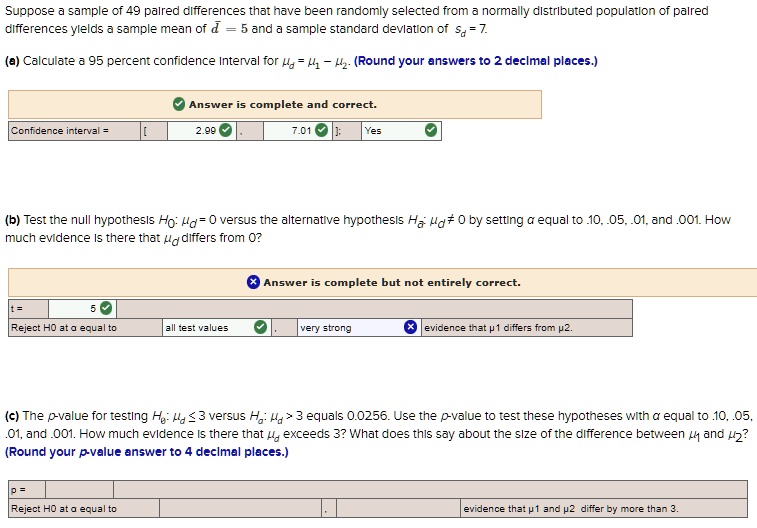
Suppose a sample of 49 paired differences that have been randomly selected from a normally distributed population of paired differences yields a sample mean of $\bar{d} = 5$ and a sample standard deviation of $s_d = 7$.
(a) Calculate a 95 percent confidence interval for $\mu_d = \mu_1 - \mu_2$. (Round your answers to 2 decimal places.)
Answer is complete and correct.
Confidence interval = [
2.99
7.01 ]:
Yes
(b) Test the null hypothesis $H_0: \mu_d = 0$ versus the alternative hypothesis $H_a: \mu_d \neq 0$ by setting $\alpha$ equal to .10, .05, .01, and .001. How much evidence is there that $\mu_d$ differs from 0?
t = 5
Reject $H_0$ at $\alpha$ equal to all test values
Answer is complete but not entirely correct.
very strong
evidence that $\mu_1$ differs from $\mu_2$.
(c) The p-value for testing $H_0: \mu_d \leq 3$ versus $H_a: \mu_d > 3$ equals 0.0256. Use the p-value to test these hypotheses with $\alpha$ equal to .10, .05, .01, and .001. How much evidence is there that $\mu_d$ exceeds 3? What does this say about the size of the difference between $\mu_1$ and $\mu_2$?
(Round your p-value answer to 4 decimal places.)
p =
Reject $H_0$ at $\alpha$ equal to evidence that $\mu_1$ and $\mu_2$ differ by more than 3.