Ace - AI Tutor
Ask Our Educators
Textbooks
My Library
Flashcards
Scribe - AI Notes
Notes & Exams
Download App
larry sanchez

larry s.

Divider

Questions asked

BEST MATCH

Question: Classify each of the characteristics as lock-and-key model or induced-fit model or both. 1) active site is rigid 2) enzyme is substrate specific 3) substrate shape is modified 4) active site is flexible 5) enzyme returns to initial shape after catalysis 6) active site-substrate interaction induces an optimal fit for catalysisClassify each of the characteristics as lock-and-key model or induced-fit model or both. 1) active site is rigid 2) enzyme is substrate specific 3) substrate shape is modified 4) active site is flexible 5) enzyme returns to initial shape after catalysis 6) active site-substrate interaction induces an optimal fit for catalysis

View Answer
divider
BEST MATCH

In Mexico, avocados are 8.7 pesos per kilogram. What is the cost in cents of an avocado that weighs 0.45 lb if the exchange rate is 2.06 pesos to the dollar

View Answer
divider
BEST MATCH

Suppose economists estimate that a 10 percent increase in the price of frisbees would reduce the quantity demanded by 5 percent. This means that the elasticity of demand for frisbees is: Oa. -5.0 Ob. -0.5 Oc. -50 Od. -2.0

View Answer
divider
BEST MATCH

When glycogen loading using the modified/recommended method, the athlete is likely to have severe ketosis during the process. True False

View Answer
divider
BEST MATCH

Calculate the weight of a jar of castor oil if it has a mass of 450g. Answer to one decimal place.

View Answer
divider
BEST MATCH

(37.1) A block of mass M=20kg is constrained to move in one-dimension. At time t=0 s the block is at rest. (a) At a later time t_(n)=10s the block is moving with velocity 4(m)/(s). (i) Determine the net impulse that was received by the block during the time interval from t=0 s to t=t_(c)=10 s. (ii) Determine the net amount of work performed on the block during the time interval from t=0s to t=t_(a)=10s. (iii) Compute the average net power input to the block during the time interval from t=0s to t=t_(a)=10s. (b) At a still later time t_(b)=20>t_(a)=10 (both in seconds) the block is moving with velocity 8(m)/(s). (i) Determine the net impulse that was received by the block during the time interval from t=t_(a)=10s to t=t_(b)=20s. (ii) Determine the net amount of work performed on the block during the time interval from t=t_(a)=10s to t=t_(b)=20s. (iii) Compute the average net power input to the block during the time interval from t=t_(a)=10s to t=t_(b)=20s. (c) (i) Determine the net impulse that was received by the block during the time interval fram t=0s to t=t_(b)=20s. (ii) Determine the net amount of work performed on the block during the time interval from t=0s to t=t_(b)=20s. (iii) Compute the average net power input to the block during the time interval from t=0s to t=t_(b)=20s. Problem Set #3 371 A block of mass M = 20 kg is constrained to move in one-dimension.At time t=0sthe block isat rest. a) At a later time t.=10s the block is moving with velocity 4m/s (i Determine the net impulse that was received by the block during the time interval fromt=0stot=t=10s (ii) Determine the net amount of work performed on the block during the time interval fromt=0stot=t=10s iii Compute the average net power input to the block during the time interval from t=0stot=ta=10s. (b At a still later time t=20> ta=10(both in seconds the block is moving with velocity 8m/s i Determine the net impulse that was received by the block during the time interval from=ta=10stot=tb=20s. ii) Determine the net amount of work performed on the block during the time interval fromt=ta=10stot=tb=20s. ii Compute the average net power input to the block during the time interval from =ta=10tot=tb=20s. (c(i Determine the net impulse that was received by the block during the time interval framt=0stot=t=20a ii Determine the net amount of work performed on the block during the time interva fromt=0to1=tb=20s i Compute the average net power input to the block during the time interval fron =0so1==20s Problem Set#3

View Answer
divider
BEST MATCH

7) Suppose we have the following data: \begin{tabular}{|c|c|c|c|c|c|c|c|c|c|} \hline x & 1.0 & 1.0 & 2.0 & 3.3 & 3.3 & 4.0 & 4.0 & 4.0 & 4.7 & 5.0 \\ \hline y & 2.3 & 1.8 & 2.8 & 1.8 & 3.7 & 2.6 & 2.6 & 2.2 & 3.2 & 2.0 \\ \hline \end{tabular} \begin{tabular}{|c|c|c|c|c|c|c|c|} \hline x & 5.6 & 5.6 & 5.6 & 6.0 & 6.0 & 6.5 & 6.9 \\ \hline y & 3.5 & 2.8 & 2.1 & 3.4 & 3.2 & 3.4 & 5.0 \\ \hline \end{tabular} Perform hypothesis test for the significance of regression. Solve in Minitab and use ANOVA output in the test.

View Answer
divider
BEST MATCH

4 Discharge tanks Pipe B 5 3 Pipe C Supply tank Pipe A 1 2 Pump

View Answer
divider
BEST MATCH

Liquid Flow EXAMPLE 2-14. Bernoulli's Equation A fluid ($\gamma$ = 0.0324 lbs/in³) flows at a constant flow rate of 300 in³/s through the system shown in Figure 2-10. The areas are $A_1$ = 2 in² and $A_2$ = 1 in². If the pressure at point 1 is 150 psi, determine the pressure at point 2.

View Answer
divider
BEST MATCH

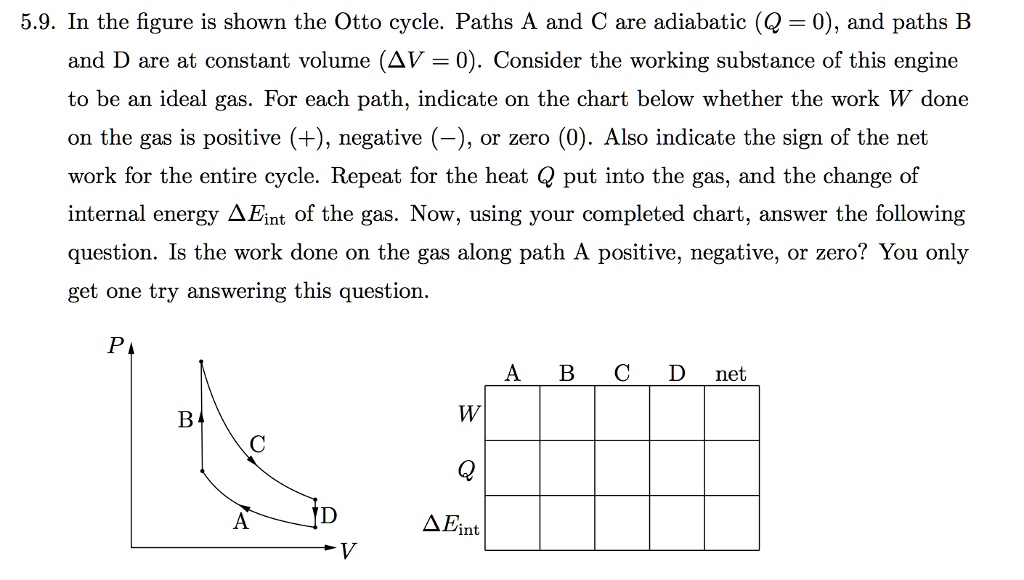
5.9. In the figure is shown the Otto cycle. Paths A and C are adiabatic (Q = 0), and paths B and D are at constant volume (V = 0). Consider the working substance of this engine to be an ideal gas. For each path, indicate on the chart below whether the work W done on the gas is positive (+), negative (-), or zero (0). Also indicate the sign of the net work for the entire cycle. Repeat for the heat Q put into the gas, and the change of internal energy Eint of the gas. Now, using your completed chart, answer the following question. Is the work done on the gas along path A positive, negative, or zero? You only get one try answering this question. A B c D net B M Q A Eint
View Answer
divider