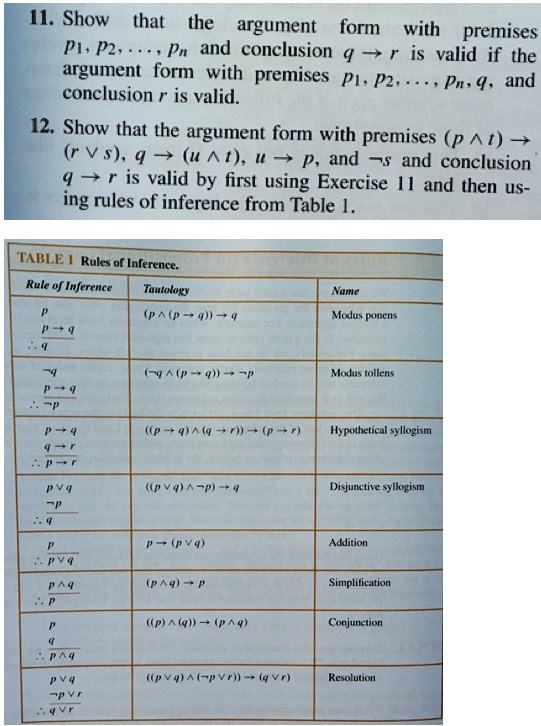
11. Show that the argument form with premises
P1, P2,..., Pn and conclusion q ? r is valid if the
argument form with premises P1, P2,..., Pn, q, and
conclusion r is valid.
12. Show that the argument form with premises $(p \land t) \to
(r \lor s)$, $q \to (u \land t)$, $u \to p$, and $\neg s$ and conclusion
q ? r is valid by first using Exercise 11 and then us-
ing rules of inference from Table 1.
TABLE 1 Rules of Inference.
Rule of Inference
Tautology
Name
p
p ? q
$(p \land (p \to q)) \to q$
Modus ponens
...
q
$\neg q$
$\neg p \to q$
$(\neg q \land (p \to q)) \to \neg p$
Modus tollens
...
$\neg p$
p ? q
((p ? q) \land (q ? r)) ? (p ? r)
Hypothetical syllogism
q ? r
...
p ? r
p \lor q
((p \lor q) \land \neg p) \to q$
Disjunctive syllogism
$\neg p$
...
q
p
p ? (p \lor q)
Addition
...
p \lor q
p \land q
$(p \land q) \to p$
Simplification
...
p
p
$(p \land q) \to (p \land q)$
Conjunction
q
...
p \land q
p \lor q
$\neg p \lor r$
$((p \lor q) \land (\neg p \lor r)) \to (q \lor r)$
Resolution
...
q \lor r