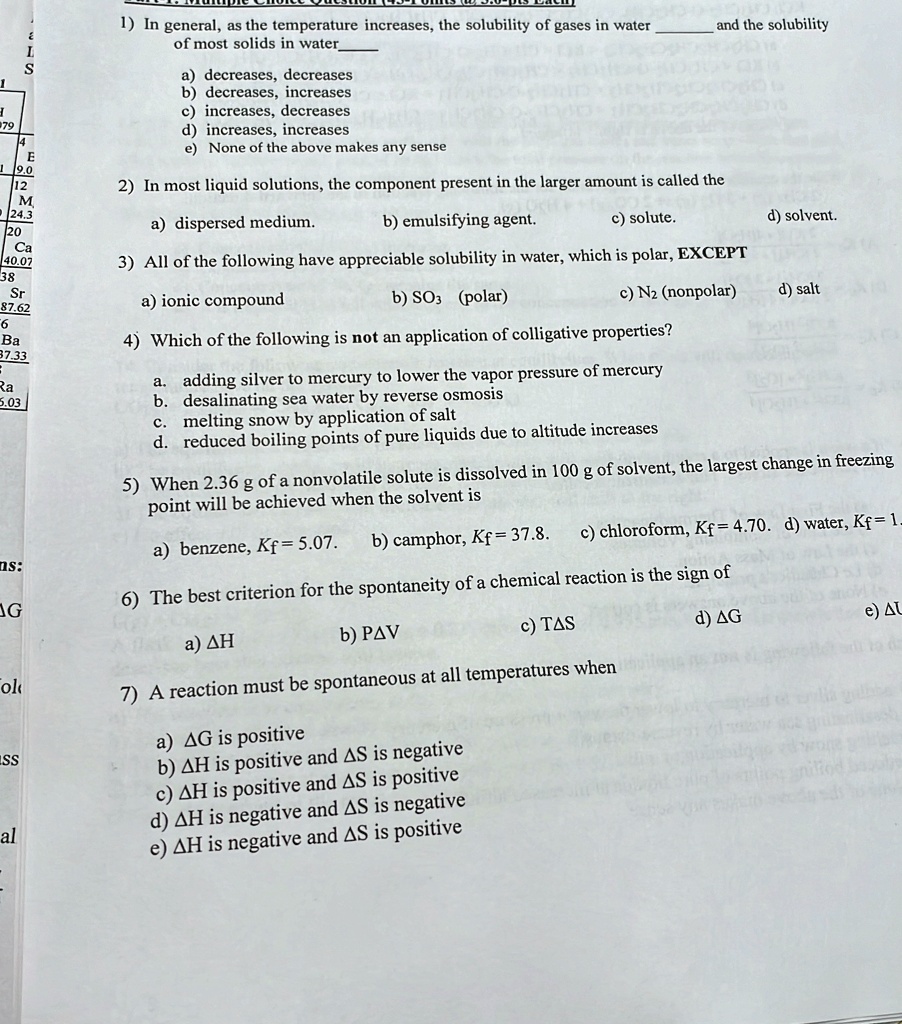
In general, as the temperature increases, the solubility of gases in water and the solubility of most solids in water
a) decreases, decreases
b) decreases, increases
c) increases, decreases
d) increases, increases
e) None of the above makes any sense
In most liquid solutions, the component present in the larger amount is called the
a) dispersed medium.
b) emulsifying agent.
c) solute.
d) solvent.
All of the following have appreciable solubility in water, which is polar, EXCEPT
a) ionic compound
b) SO3 (polar)
c) N2 (nonpolar)
Which of the following is not an application of colligative properties?
a. adding silver to mercury to lower the vapor pressure of mercury
b. desalinating sea water by reverse osmosis
c. melting snow by application of salt
d. reduced boiling points of pure liquids due to altitude increases
When 2.36g of a nonvolatile solute is dissolved in 100g of solvent, the largest change in freezing point will be achieved when the solvent is
a) benzene, Kf=5.07.
b) camphor, Kf=37.8.
c) chloroform, Kf=4.70.
d) water, Kf=1
The best criterion for the spontaneity of a chemical reaction is the sign of
a) ΔH
b) PΔV
c) TΔS
d) ΔG
e) ΔI
A reaction must be spontaneous at all temperatures when
a) ΔG is positive
b) ΔH is positive and ΔS is negative
c) ΔH is positive and ΔS is positive
d) ΔH is negative and ΔS is negative
e) ΔH is negative and ΔS is positive