Learning Goal:
To understand how to calculate capacitance, voltage, and charge for a combination of capacitors connected in series.
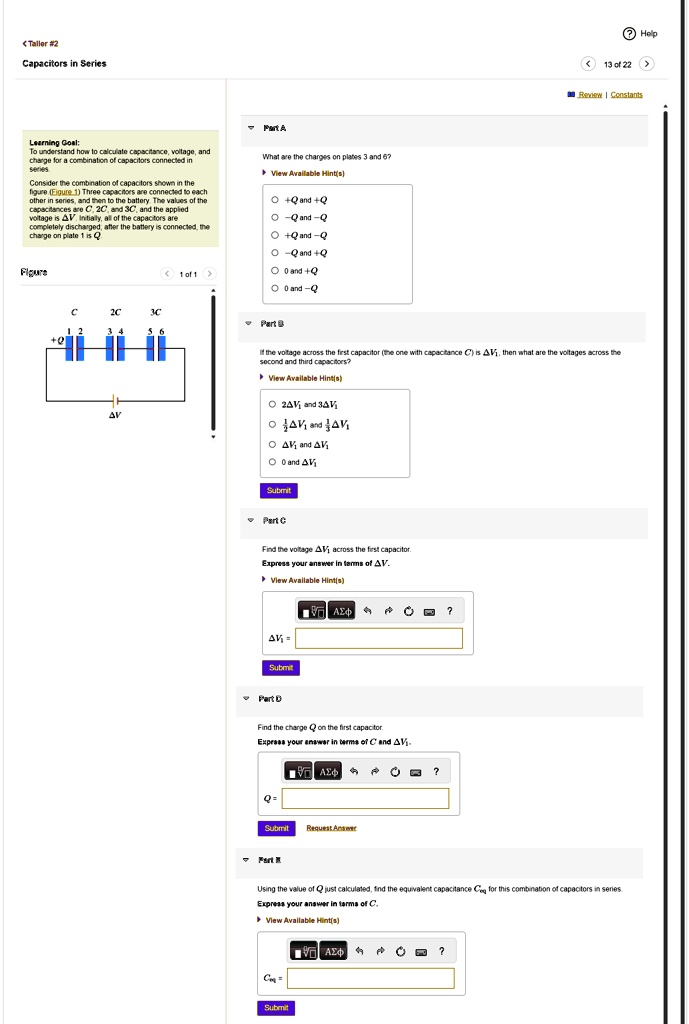
Consider the combination of capacitors shown in the figure. (Figure 1) Three capacitors are connected to each other in series, and then to the battery. The values of the capacitances are C, 2C, and 3C, and the applied voltage is ΔV. Initially, all of the capacitors are completely discharged; after the battery is connected, the charge on plate 1 is Q.
Figure
Part D
Find the charge Q on the first capacitor
Express your answer in terms of C and ΔV_(1).
2ΔV_(1) and 3ΔV_(1)
(1)/(2)ΔV_(1) and (1)/(3)ΔV_(1)
ΔV_(1) and ΔV_(1)
0 and ΔV_(1)
If the voltage across the first capacitor (the one with capacitance C) is ΔV_(1), then what are the voltages across the second and third capacitors?
View Available Hint(s)
Part C
Find the voltage ΔV_(1) across the first capacitor.
Express your answer in terms of ΔV.
View Available Hint(s)
√(◻)(◻)AΣφ
ΔV_(1)=
What are the charges on plates 3 and 6?
View Available Hint
+Q and +Q
-Q and -Q
+Q and -Q
-Q and +Q
0 and +Q
0 and -Q
Part B
Part E
Using the value of Q just calculated, find the equivalent capacitance C_(eq) for this combination of capacitors in series
Express your answer in terms of C.
View Available Hint(s)
C_(eq)=