In the CHOOZ experiment, a neutrino detector was positioned a distance L = 1 km from a nuclear reactor emitting antineutrinos of mean energy E ~ 3 MeV. The number of antineutrino interactions observed was consistent with the number predicted assuming no antineutrino oscillations, giving the result P() = 1.01 ± 0.04 (the uncertainty is reported at the 68% Confidence Level).
a) Show that neutrino oscillations associated with the (solar) mass-squared difference |m| = 7.5 × 10^(-5) can be neglected for the CHOOZ experiment, and that
P(vv) = 1 - sin^2(2θ)sin^2(1.27Δm^2L/E),
where
Δm^2 = 2.3 × 10^(-4) eV^2,
L = 1 km,
E = 3 MeV.
b) In the limit m >> E/L, explain why a given measurement, Pb, of the survival probability P(vv) determines the neutrino mixing to be sin^2(2θ) = 1 - Pb/4E/L.
c) In the limit m << E/L, show that a given measurement, Pb, of the survival probability P(vv) determines the neutrino mixing to be sin^2(2θ) = 1 - Pb/4E/L, with constant of proportionality C = 1 - Pb/4E/L.
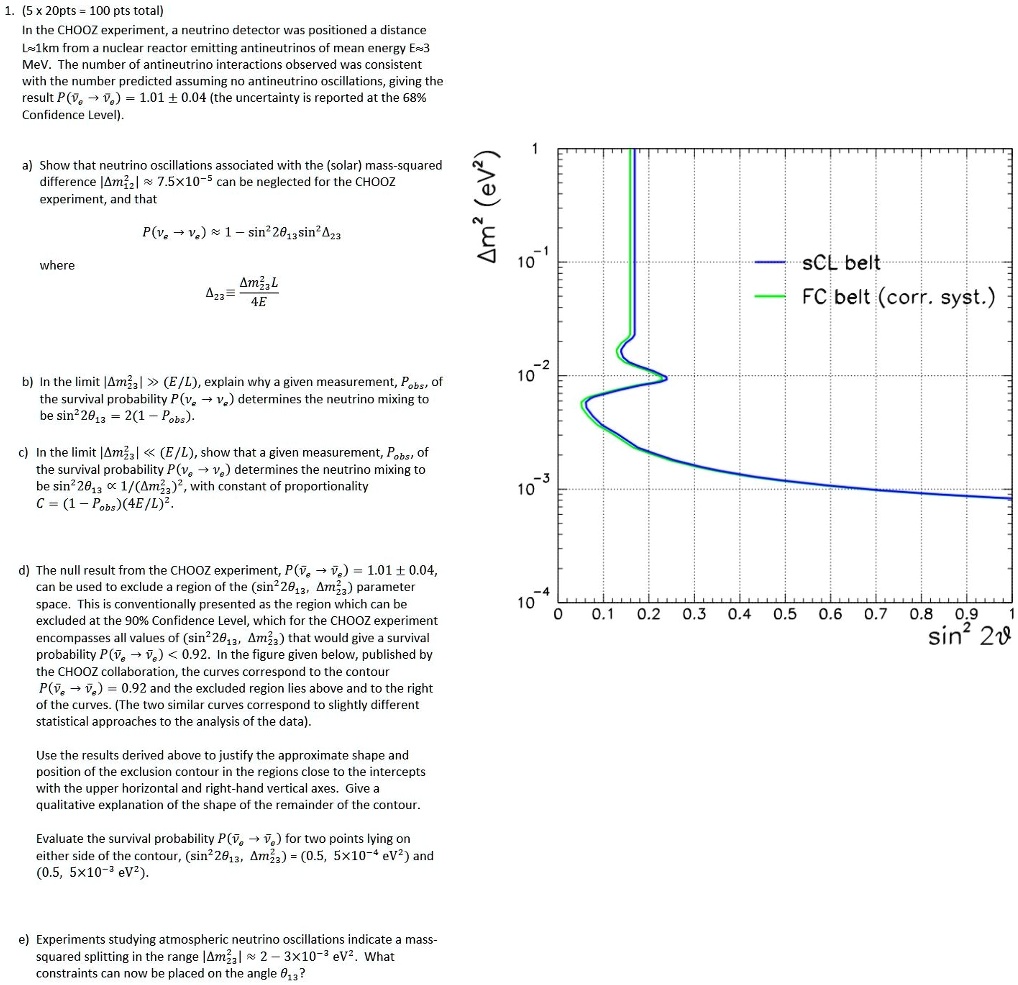
d) The null result from the CHOOZ experiment, Pv = 1.01 ± 0.04, can be used to exclude a region of the (sin^2(2θ), Δm^2) parameter space. This is conventionally presented as the region which can be excluded at the 90% Confidence Level, which for the CHOOZ experiment encompasses all values of (sin^2(2θ), Δm^2) that would give a survival probability Pvv < 0.92. In the figure given below, published by the CHOOZ collaboration, the curves correspond to the contour Pvv = 0.92 and the excluded region lies above and to the right of the curves. (The two similar curves correspond to slightly different statistical approaches to the analysis of the data)
e) Experiments studying atmospheric neutrino oscillations indicate a mass-squared splitting in the range Δm^2 = 3 × 10^(-3) - 10^(-2) eV^2. What constraints can now be placed on the angle θ?