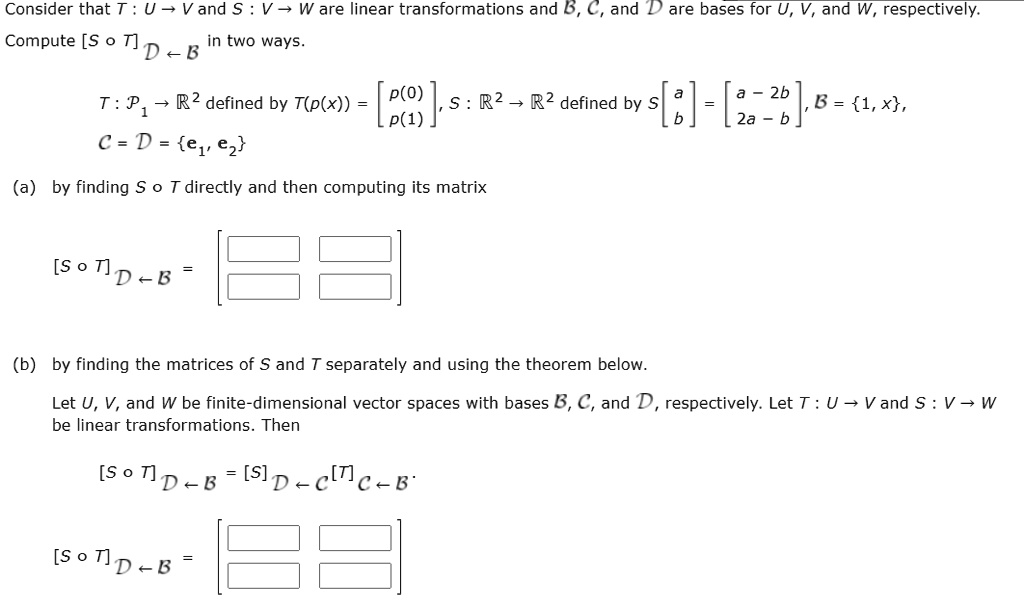
Consider that $T: U \to V$ and $S: V \to W$ are linear transformations and $B$, $C$, and $D$ are bases for $U$, $V$, and $W$, respectively.
Compute $[S \circ T]_{D \leftarrow B}$ in two ways.
$T: P_1 \to \mathbb{R}^2$ defined by $T(p(x)) = \begin{bmatrix} p(0) \ p(1) \end{bmatrix}$, $S: \mathbb{R}^2 \to \mathbb{R}^2$ defined by $S\begin{bmatrix} a \ b \end{bmatrix} = \begin{bmatrix} a - 2b \ 2a - b \end{bmatrix}$, $B = \{1, x\}$,
$C = D = \{e_1, e_2\}$
(a) by finding $S \circ T$ directly and then computing its matrix
$[S \circ T]_{D \leftarrow B} =
$
(b) by finding the matrices of $S$ and $T$ separately and using the theorem below.
Let $U$, $V$, and $W$ be finite-dimensional vector spaces with bases $B$, $C$, and $D$, respectively. Let $T: U \to V$ and $S: V \to W$ be linear transformations. Then
$[S \circ T]_{D \leftarrow B} = [S]_{D \leftarrow C}[T]_{C \leftarrow B}$
$[S \circ T]_{D \leftarrow B} = $