4. Chicago Turkey is considering a new turkey farm to service its western
region stores. The stores currently require 650,000 turkeys per year, and
they are purchased from various local turkey farms for an average price of
$8 per bird. The managers believe that their new farm would lower the
cost per bird to $7, while maintaining the average selling price of $10 per
bird. However, due to the centralized structure of this operation, shipping
expenses will increase to $1.25 per bird from the current $1.00. The firm
will need to increase its inventory of live turkeys by $45,000. It will cost
$150,000 to purchase the land and $300,000 to construct the buildings and
purchase equipment. In addition, labor expense will rise by $250,000 per
year. The buildings and equipment will be depreciated using the straight-
line method over five years to a salvage value of $100,000. After five
years, the company will sell the farm for $300,000 ($100,000 for the
buildings and equipment, $200,000 for the land). The firm's marginal tax
rate is 35%, and note that land is not depreciable.
a. Calculate the initial outlay, after-tax cash flows, and terminal cash
flow for this project.
b. If the WACC is 11%, calculate the payback period, discounted
payback period, NPV, PI, IRR, and MIRR.
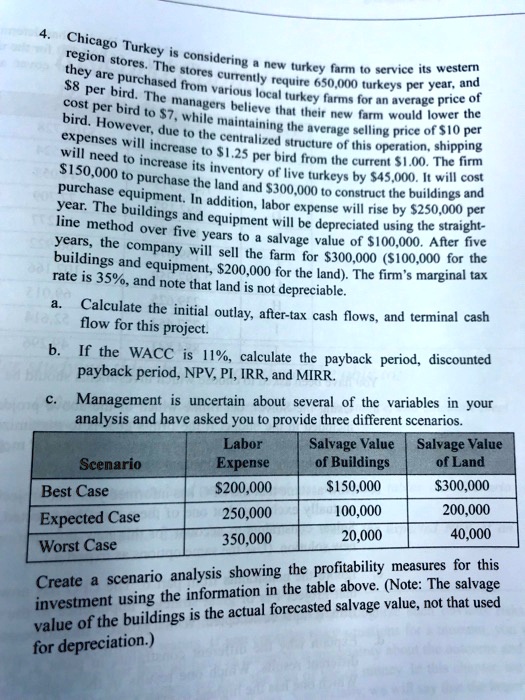
c. Management is uncertain about several of the variables in your
analysis and have asked you to provide three different scenarios.
Labor
Salvage Value
Scenario
Expense
of Buildings
Salvage Value
of Land
Best Case
$200,000
$150,000
$300,000
Expected Case
250,000
100,000
200,000
Worst Case
350,000
20,000
40,000
Create a scenario analysis showing the profitability measures for this
investment using the information in the table above. (Note: The salvage
value of the buildings is the actual forecasted salvage value, not that used
for depreciation.)