Questions asked
Question 17 3 pts is: In regression, the equation that describes how the response variable (y) is related to the explanatory variable (x) The correlation model The regression model Used to compute the correlation coefficient None of these alternatives is correct
A student sets up the following equation to convert a measurement. (The ? stands for a number the student is going to calculate.) Fill in the missing part of this equation. Note: your answer should be in the form of one or more fractions multiplied together. \left(25. \frac{kg \cdot m}{s}\right) \boxed{?} = ? \frac{g \cdot cm}{s}
When bicarbonate forms , the resulting hydrogen ion often binds to amino acids in hemoglobin to produce the Bohr Effect , which a . increases the dissociation of from iron in hemoglobin b . increases the affinity of O2 for the iron in hemoglobin . increases the affinity of CO2 for the iron in hemoglobin d . decreases the affinity of O2 for the iron in hemoglobin . a and d are correct
24. You are treating a patient you suspect has a developing epidural hematoma. Which of the following is your MOST important intervention?
\int_2^{12} \frac{12}{\sqrt[3]{x - 2}} dx = \text{ } (If the integral diverges to \infty or -\infty, type oo or -oo; if the integral diverges in some other manner, type DNE.)
Consider the following rational function. Step 3 of 3: Find the oblique asymptote(s), if any, of this function. f(x) = \frac{-7}{-2x + 3}
Suppose that new regulations make it more difficult for prospective employees to work in an industry; all else equal, we would expect wages in that industry to: a) rise b) fall c) remain unchanged Suppose that new regulations make it more difficult for prospective employees to work in an industry; all else equal, we would expect wages in that industry to: a) rise b)fall c) remain unchanged
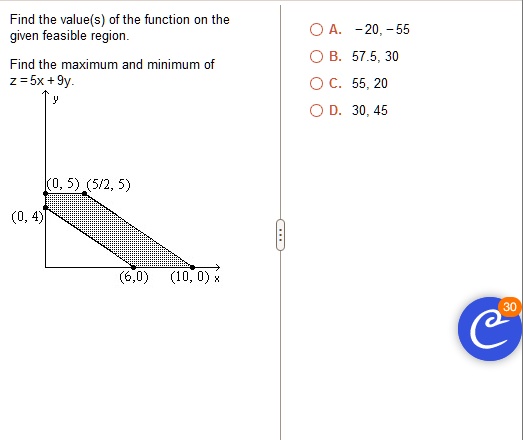
Find the value(s) of the function on the given feasible region. Find the maximum and minimum of z = 5x + 9y. y ? ?. -20, -55 ?. 57.5, 30 ? C. 55, 20 ? D. 30, 45 (0, 4) (0, 5) (5/2, 5) (6, 0) (10, 0) x
2. Air is in crossflow over the outside of a square duct oriented in one of two directions: (A) the air hits the square on a corner, and (B) the air hits the square duct perpendicular to one side. The air temperature is 15 $^\circ$C and has a bulk fluid velocity of 1.45 m/s, and the surface temperature of the 40.0 meter long duct is 39 $^\circ$C. The duct has a square cross-section with an outside dimension of 0.58 m. What is the rate of heat transfer from the duct to the air for each of the flow orientations?
Attempts Keep the Highest / 4 8. Problem 5.19 (Future Value of an Annuity) eBook Problem Walk-Through Your client is 31 years old. She wants to begin saving for retirement, with the first payment to come one year from now. She can save $3,000 per year, and you advise her to invest it in the stock market, which you expect to provide an average return of 8% in the future. a. If she follows your advice, how much money will she have at 65? De not round intermediate calculations. Round your answer to the nearest cent. b. How much will she have at 70? Do not round intermediate calculations. Round your answer to the nearest cent. c. She expects to live for 20 years if she retires at 65 and for 15 years if she retires at 70. If her investments continue to earn the same rate, how much will she be able to withdraw at the end of each year after retirement at each retirement age? Do not round intermediate calculations, Round your answers to the nearest cent. Annual withdrawals if she retires at 65: $ Annual withdrawals if she retires at 70: $ Grade It Now Save & Continue Continue without saving