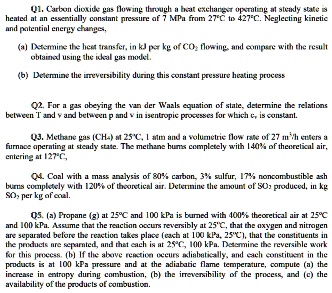
Q1. Carbon dioxide gas flowing through a heat exchanger operating at steady state is heated at an essentially constant pressure of 7 MPa from 27°C to 427°C. Neglecting kinetic and potential energy changes,
(a) Determine the heat transfer, in kJ per kg of CO? flowing, and compare with the result obtained using the ideal gas model.
(b) Determine the irreversibility during this constant pressure heating process
Q2. For a gas obeying the van der Waals equation of state, determine the relations between T and v and between p and v in isentropic processes for which $c_p$ is constant.
Q3. Methane gas (CH?) at 25°C, 1 atm and a volumetric flow rate of 27 m³/h enters a furnace operating at steady state. The methane burns completely with 140% of theoretical air, entering at 127°C,
Q4. Coal with a mass analysis of 80% carbon, 3% sulfur, 17% noncombustible ash burns completely with 120% of theoretical air. Determine the amount of SO? produced, in kg SO? per kg of coal.
Q5. (a) Propane (g) at 25°C and 100 kPa is burned with 400% theoretical air at 25°C and 100 kPa. Assume that the reaction occurs reversibly at 25°C, that the oxygen and nitrogen are separated before the reaction takes place (each at 100 kPa, 25°C), that the constituents in the products are separated, and that each is at 25°C, 100 kPa. Determine the reversible work for this process. (b) If the above reaction occurs adiabatically, and each constituent in the products is at 100 kPa pressure and at the adiabatic flame temperature, compute (a) the increase in entropy during combustion, (b) the irreversibility of the process, and (c) the availability of the products of combustion.