(1 point)
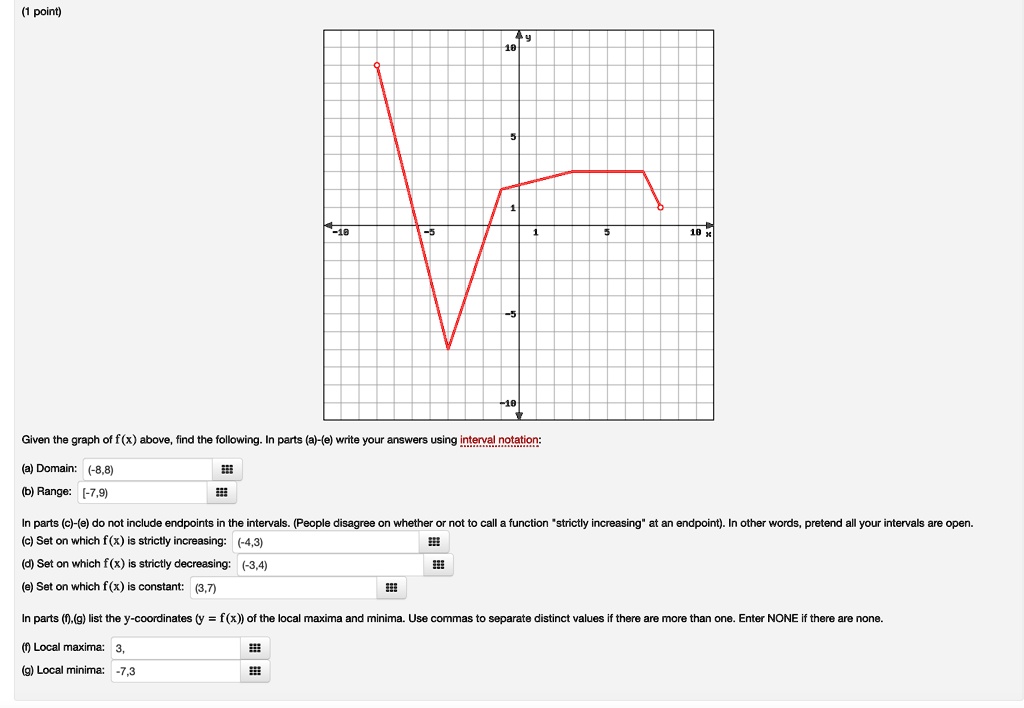
Given the graph of \(f(x)\) above, find the following. In parts (a)-(e) write your answers using interval notation:
(a) Domain: \((-8,8)\)
(b) Range: \([-7,9)\)
In parts (c)-(e) do not include endpoints in the intervals. (People disagree on whether or not to call a function \"strictly increasing\" at an endpoint). In other words, pretend all your intervals are open.
(c) Set on which \(f(x)\) is strictly increasing: \((-4,3)\)
(d) Set on which \(f(x)\) is strictly decreasing: \((-3,4)\)
(e) Set on which \(f(x)\) is constant: \((3,7)\)
In parts (f), (g) list the y-coordinates \((y = f(x))\) of the local maxima and minima. Use commas to separate distinct values if there are more than one. Enter NONE if there are none.
(f) Local maxima: 3,
(g) Local minima: -7,3