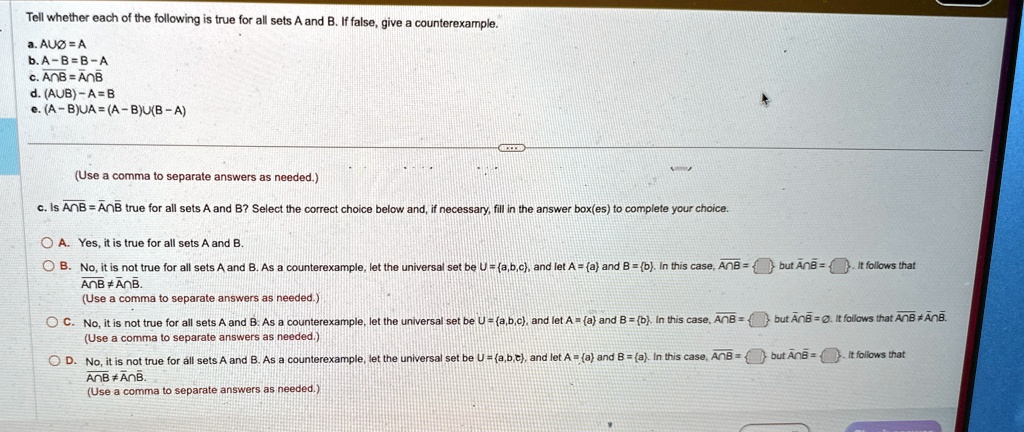
Tell whether each of the following is true for all sets A and B. If false, give a counterexample.
a. $A \cup D = A$
b. $A - B = B - A$
c. $A \cap B = \overline{A} \cap \overline{B}$
d. $(A \cup B) - A = B$
e. $(A - B) \cup A = (A - B) \cup (B - A)$
(Use a comma to separate answers as needed.)
c. Is $A \cap B = \overline{A} \cap \overline{B}$ true for all sets A and B? Select the correct choice below and, if necessary, fill in the answer box(es) to complete your choice.
A. Yes, it is true for all sets A and B.
B. No, it is not true for all sets A and B. As a counterexample, let the universal set be $U = \{a, b, c\}$, and let $A = \{a\}$ and $B = \{b\}$. In this case, $A \cap B = \boxed{}$ but $\overline{A} \cap \overline{B} = \boxed{}$. It follows that
$A \cap B \neq \overline{A} \cap \overline{B}$.
(Use a comma to separate answers as needed.)
C. No, it is not true for all sets A and B. As a counterexample, let the universal set be $U = \{a, b, c\}$, and let $A = \{a\}$ and $B = \{b\}$. In this case, $A \cap B = \boxed{}$ but $\overline{A} \cap \overline{B} = \boxed{}$. It follows that $A \cap B \neq \overline{A} \cap \overline{B}$.
(Use a comma to separate answers as needed.)
D. No, it is not true for all sets A and B.
$A \cap B \neq \overline{A} \cap \overline{B}$.
As a counterexample, let the universal set be $U = \{a, b, c\}$, and let $A = \{a\}$ and $B = \{a\}$.
In this case, $A \cap B = \boxed{}$ but $\overline{A} \cap \overline{B} = \boxed{}$. It follows that
(Use a comma to separate answers as needed.)