Ace - AI Tutor
Ask Our Educators
Textbooks
My Library
Flashcards
Scribe - AI Notes
Notes & Exams
Download App
Lauren

Lauren

Divider

Viewed Questions

(a) Find the present and future value of an income stream of $\$ 6000$ per year for a period of 10 years if the interest rate, compounded continuously, is $5 \%$
(b) How much of the future value is from the income stream? How much is from interest?

(a) Find the present and future value of an income stream of $\$ 6000$ per year for a period of 10 years if the interest rate, compounded continuously, is $5 \%$ (b) How much of the future value is from the income stream? How much is from interest?

Applied Calculus

Antiderivatives and Applications

Application: Present and Future Value

Questions asked

ANSWERED

Danielle Fairburn verified

Numerade educator

Find the integral int t sin(3t) dt. NOTE: Enclose arguments of functions in parentheses. For example, sin(2x). int t sin(3t) dt = [ ] + C

View Answer
divider
ANSWERED

Steven Clarke verified

Numerade educator

Find the integral int t e^{10 t} d t. int t e^{10 t} d t = [ ] + C

View Answer
divider
ANSWERED

Eduard Sanchez verified

Numerade educator

(a) Find the present and future value of an income stream of $6000 per year for a period of 15 years if the interest rate, compounded continuously, is 7%. NOTE: Round your answer to the nearest cent. Present value = $ Future value = $

View Answer
divider
ANSWERED

Justin Swantek verified

Numerade educator

Find the integral given below. Check your answer by differentiation. [ int x sqrt{2 x^{2}+7} d x ] [ int x sqrt{2 x^{2}+7} d x=square+C ]

View Answer
divider
ANSWERED

Keondre Parker verified

Numerade educator

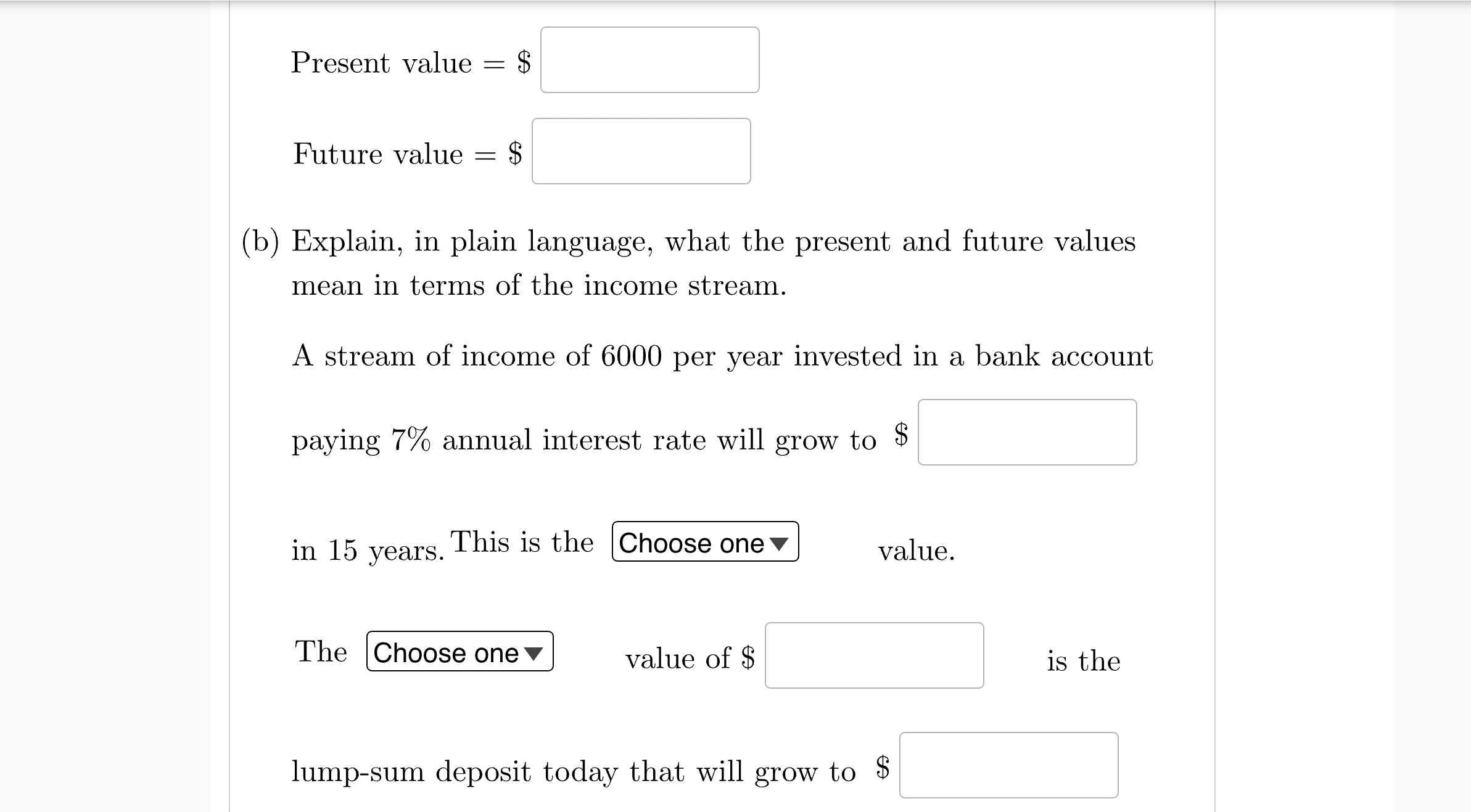
Present value = $ Future value = $ (b) Explain, in plain language, what the present and future values mean in terms of the income stream. A stream of income of 6000 per year invested in a bank account paying 7% annual interest rate will grow to $ in 15 years. This is the Choose one value. The Choose one value of $ is the lump-sum deposit today that will grow to $
View Answer
divider
ANSWERED

Gregory Higby verified

Numerade educator

Find the indefinite integral. $$int e^{-0.01t} dt = oxed{} + C$$

View Answer
divider
ANSWERED

Vincenzo Zaccaro verified

Numerade educator

Find the integral given below. Check your answer by differentiation. [ egin{array}{c} int frac{sin (sqrt{x})}{sqrt{x}} d x \ int frac{sin (sqrt{x})}{sqrt{x}} d x=square+C end{array} ]

View Answer
divider
ANSWERED

Vincenzo Zaccaro verified

Numerade educator

Graph y = 1/x^2 and y = 1/x^3 on the same axes. Which do you think is larger: ?[1 to ?] 1/x^2 dx or ?[1 to ?] 1/x^3 dx? Why? Select each correct answer. [ ] ?[1 to ?] 1/x^2 dx is greater because the area under y = 1/x^2 is less than the area under the graph of y = 1/x^3. [ ] ?[1 to ?] 1/x^3 dx is greater because the area under y = 1/x^3 is greater than the area under the graph of y = 1/x^2. [ ] ?[1 to ?] 1/x^3 dx is greater because the graph of y = 1/x^3 is above (greater than) the graph of y = 1/x^2. [ ] ?[1 to ?] 1/x^2 dx is greater because the graph of y = 1/x^2 is below (less than) the graph of y = 1/x^3. [ ] ?[1 to ?] 1/x^2 dx is greater because the graph of y = 1/x^2 is above (greater than) the graph of y = 1/x^3. [ ] ?[1 to ?] 1/x^2 dx is greater because the area under y = 1/x^2 is greater than the area under the graph of y = 1/x^3.

View Answer
divider
ANSWERED

Vincenzo Zaccaro verified

Numerade educator

In this problem, you will evaluate the following improper integral: [ int_{1}^{infty} frac{1}{x^{8}} d x ] (a) Use the Fundamental Theorem to find ( int_{1}^{b} frac{1}{x^{8}} d x ). Your answer will contain ( b ). NOTE: Enter the exact answer. [ int_{1}^{b} frac{1}{x^{8}} d x=frac{1}{-7 b^{7}}-frac{1}{-7} ] (b) Now take the limit as ( b ightarrow infty ). NOTE: Enter the exact answer. [ lim _{b ightarrow infty} int_{1}^{b} frac{1}{x^{8}} d x= ]

View Answer
divider